

You reach for a high shelf or try to find a comfortable sleeping position, only to be met with a sharp, familiar ache that stops you in your tracks. This persistent discomfort often leaves you wondering if you’re dealing with a rotator cuff tear, bursitis, or the onset of frozen shoulder. We understand that living with this uncertainty is exhausting, especially when sharp pain during overhead movements prevents a good night’s sleep. If you’re in Abingdon, Witney, or Central Oxford, you deserve a faster route to clarity than current hospital wait times allow.
Choosing a diagnostic ultrasound for shoulder pain provides an immediate, high-resolution view of your soft tissues, allowing us to see exactly how your joint functions in real-time. This professional, expert-led tool helps our specialists identify the precise cause of your symptoms without the delays of the traditional system. It’s the most effective way to determine if you need targeted exercise rehabilitation or specialist injections to restore your mobility and comfort.
This guide outlines how residents in Headington, Summertown, Didcot, and surrounding areas like Eynsham, Faringdon, and West Oxford can access expert imaging. You’ll learn how to move from confusion to a clear, evidence-based recovery plan. Whether you’re based in Kennington, Marcham, or Farmoor, we’ll show you how to secure the answers you need to start your journey back to a pain-free life.
Key Takeaways
- Learn why dynamic imaging captures shoulder injuries that static MRI scans often miss by observing the joint in real-time movement.
- Understand how a diagnostic ultrasound for shoulder pain provides an accurate, non-invasive path to identifying rotator cuff tears and bursitis without claustrophobia.
- Access professional imaging at convenient locations across Oxfordshire, including Abingdon, Witney, and Headington, with most appointments lasting only 20 to 30 minutes.
- Discover how clinical findings translate into immediate treatment plans, such as exercise rehabilitation or specialist shoulder injections, at our Central Oxford clinics.
- Prepare for your visit from Didcot, Summertown, or West Oxford with our practical checklist designed to streamline your path from diagnosis to recovery.
What is Diagnostic Shoulder Ultrasound and Why is it the Gold Standard?
Diagnostic musculoskeletal (MSK) ultrasound uses high-frequency sound waves to capture detailed, high-resolution images of the shoulder’s internal structures. Unlike other imaging methods, it doesn’t rely on magnetic fields or radiation. To better understand the science behind this technology, you can explore the basics of what is medical ultrasound and its clinical applications. In 2026, a diagnostic ultrasound for shoulder assessment is the preferred first-line investigation for soft tissue injuries. It provides a safer alternative to X-rays or CT scans because it involves no ionizing radiation, making it suitable for repeated use during your recovery journey.
This technology allows clinicians to observe tendons, ligaments, and muscles with exceptional clarity. Because it’s a non-invasive tool, it’s often more comfortable for patients in Abingdon, Witney, and across Oxfordshire who are already experiencing significant physical discomfort. It provides an immediate window into the joint, allowing for a level of detail that helps distinguish between similar-sounding conditions that require very different treatment approaches.
To better understand this concept, watch this helpful video:
The speed of access is another reason why ultrasound is the gold standard for private care. While the NHS target for diagnostic scans is six weeks, this target hasn’t been met since February 2017. With approximately 1.6 million people in England currently on waitlists, patients in Didcot, Headington, and Summertown often face months of uncertainty. Our clinics provide immediate answers, delivering a clinical report during your appointment so you can begin recovery without the stress of long hospital wait times.
Common Shoulder Conditions Detected by Ultrasound
A professional scan can pinpoint several specific issues that cause chronic discomfort. These include:
- Rotator cuff tears: Identifying both partial and full-thickness tears in the tendons that support joint stability.
- Subacromial bursitis: Detecting inflammation and fluid accumulation within the shoulder’s protective sacs.
- Calcific tendinitis: Visualising calcium deposits that have formed within the tendons, often causing sharp pain.
Whether you’re based in Kennington, Marcham, or Farmoor, identifying these conditions early prevents further joint degradation and chronic stiffness.
The Role of MSK Ultrasound in Modern Physiotherapy
Imaging transforms the recovery process by ensuring that private MSK physiotherapy Oxford is targeted and evidence-based. Instead of treating a general symptom, your therapist uses the scan to create a bespoke plan. This reduces the trial-and-error period often associated with rehabilitative exercises. For patients in Eynsham, Faringdon, or West Oxford, this means a faster return to daily activities. A diagnostic ultrasound for shoulder ensures your exercise rehabilitation focuses on the exact site of injury, providing a clear path from diagnosis to restoration for our Central Oxford community.
Dynamic Imaging: Seeing Your Shoulder in Motion
Static images often fail to tell the full story of a joint as complex as the shoulder. While traditional scans require you to remain perfectly still, a diagnostic ultrasound for shoulder assessment excels because it is dynamic. This means our sonographers can observe your anatomy while you move your arm through the specific ranges that trigger your pain. For patients visiting from Abingdon, Summertown, or Kennington, this real-time visualization is often the key to unlocking a diagnosis that static imaging might overlook.
During the scan, we ask you to perform the movements that cause your “painful arc.” As you lift or rotate your arm, the ultrasound probe captures the sliding of tendons and the gliding of the bursa. Contrast this with an MRI, where you must lie perfectly still inside a narrow tube for up to 45 minutes. If your discomfort only occurs during a specific overhead reach, a still image may appear normal even when a mechanical issue exists. Our clinical approach ensures that we see exactly what happens at the moment of discomfort, providing a functional assessment that static scans simply cannot match.
Identifying Subacromial Impingement (SAI)
Subacromial Impingement (SAI) is a mechanical conflict between the rotator cuff and the shoulder blade. Using dynamic imaging, we can actually see the bursa being “pinched” as you elevate your arm. Whether you live in Marcham, Headington, or Farmoor, our specialists use these real-time visuals to confirm if your pain is caused by this physical compression. This finding is transformative for your recovery plan; it shifts the focus from general rest to active, targeted rehabilitation designed to clear the impingement zone. If you are experiencing these symptoms, you may want to consider a specialist assessment to identify the exact mechanical cause.
Assessing Rotator Cuff Stability
Dynamic scanning is also essential for evaluating the severity of a rotator cuff tear. By moving the arm, we can observe if a tear widens or if the edges of the tendon remain stable under tension. Peer-reviewed research confirms that ultrasound is as accurate as an MRI for detecting tears while offering the added benefit of checking the long head of the biceps tendon during rotation. This level of detail is vital for residents in Eynsham, Didcot, and Witney seeking a definitive answer. Our facilities in Central Oxford and West Oxford are easily accessible for those in Faringdon, providing the clarity needed to choose between conservative management and surgical referral without the hospital wait times.
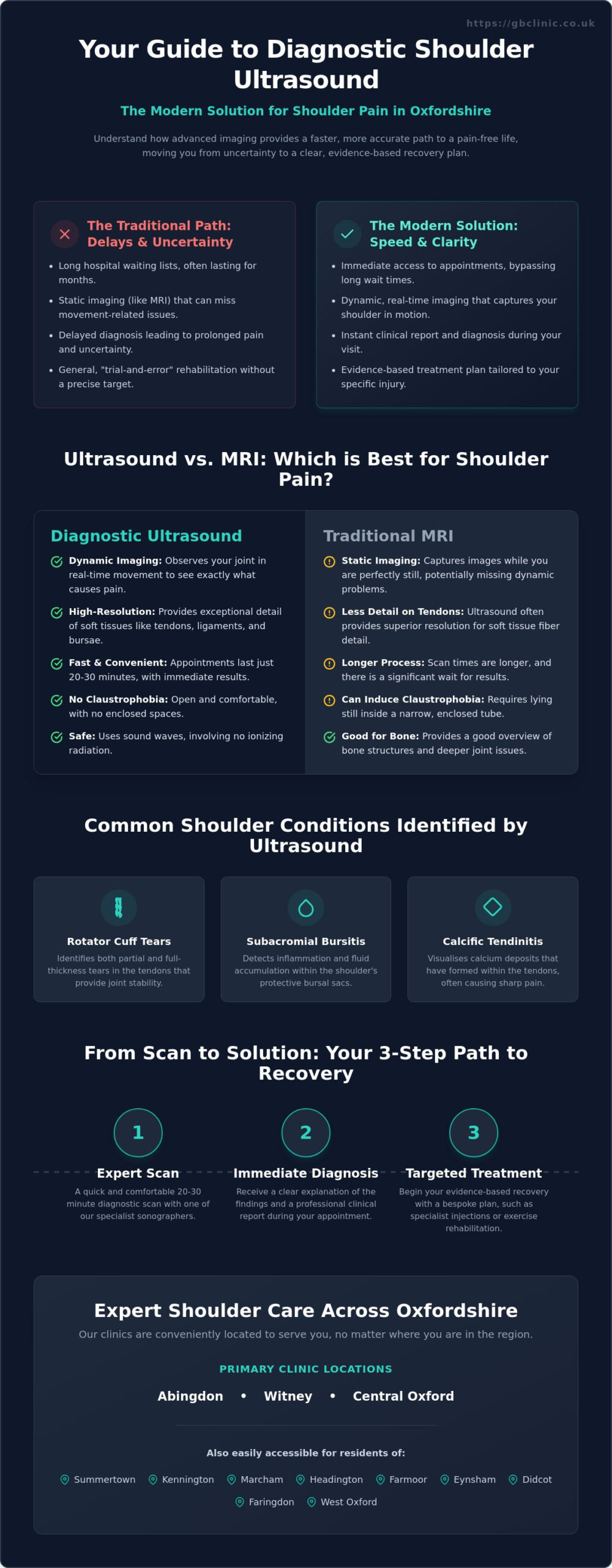
Shoulder Ultrasound vs. MRI: Which Diagnostic Path is Best?
Choosing between imaging modalities can be confusing for patients in Headington or Summertown. While both have merits, a diagnostic ultrasound for shoulder pain is frequently the superior “first-look” investigation for soft tissue injuries. In the UK in 2026, private ultrasound scans remain a more cost-effective option than MRI, which often carries higher base costs and requires mandatory specialist consultation fees. Beyond the financial aspect, the open nature of ultrasound removes the claustrophobia factor associated with lying in a narrow MRI tube for 30 to 45 minutes.
The accuracy of ultrasound for detecting rotator cuff tears is comparable to MRI, but it offers a unique clinical advantage. Research into the dynamic study of the shoulder demonstrates that ultrasound identifies functional issues that static images simply cannot capture. For residents in Abingdon and Kennington, this means a faster route to understanding why a specific movement triggers pain.
When Ultrasound Wins
Ultrasound is the preferred tool for assessing superficial structures like the bursa and the rotator cuff tendons. Its interactive nature allows you to point to the exact site of your discomfort while the sonographer scans, ensuring the clinical focus remains on your specific symptoms. It’s also entirely unaffected by metal implants. If you have a pacemaker or surgical pins from a previous procedure, ultrasound is a safe and effective choice. Our clinics are easily accessible for those in Marcham, Farmoor, and Eynsham, offering a streamlined path to a diagnostic ultrasound scan without the hospital wait times.
When an MRI May Still Be Required
There are specific clinical scenarios where an MRI is the more appropriate tool. If we suspect deep-seated joint issues, such as a labral tear or bone marrow oedema, which is essentially bone bruising, the cross-sectional depth of an MRI is necessary. It’s also the standard choice for evaluating the internal structures of the glenohumeral joint capsule or when a surgeon requires a 3D view for complex operative planning. If your symptoms suggest these deeper pathologies, we’ll guide you toward the right imaging path. This ensures that patients from Didcot, Witney, and Faringdon receive the most appropriate care for their specific condition, whether they visit our Central Oxford or West Oxford locations.
How to Prepare for Your Shoulder Ultrasound Scan in Oxfordshire
Preparing for a diagnostic ultrasound for shoulder pain is straightforward and designed to be stress-free. If you’re traveling from Abingdon, Witney, or Headington, you won’t need to worry about complex fasting or restrictive protocols. Our goal is to make the process as efficient as possible, typically completing the entire diagnostic appointment within 20 to 30 minutes. Unlike many hospital settings, you don’t usually need a GP referral to book a private scan with us. This direct access allows you to take control of your recovery timeline immediately without waiting for external paperwork.
We recommend wearing loose-fitting clothing that allows easy access to the shoulder joint. A sleeveless top or a vest is ideal, as it ensures the sonographer can move the probe freely without the need for you to fully undress. If you have any previous imaging reports or clinical letters from other providers, please bring them along. These documents help our specialists build a comprehensive picture of your clinical history and ensure the most accurate assessment of your current symptoms.
Step-by-Step: What Happens During the Appointment
Once you’re comfortable in the treatment room, the sonographer applies a small amount of hypoallergenic gel to the shoulder area. This gel ensures a clear connection between your skin and the transducer, which is the handheld device used to capture high-resolution images. As the transducer moves over your skin, you’ll see the internal structures of your shoulder on the monitor in real-time. We believe in transparency and clear communication, so our specialists will discuss the findings with you during the scan. You won’t have to wait days or weeks for a report; you’ll leave the clinic with a clear understanding of your condition and the next steps for your care.
Accessing the Clinic from Greater Oxfordshire
Our clinics are strategically located to be the convenient, local choice for residents across the region. If you’re coming from Didcot or Bicester, the journey into Central Oxford is direct, with reliable transport links and clear signage. For those in Summertown or West Oxford, our facilities are situated near major local landmarks, ensuring you spend less time traveling and more time focusing on your recovery.
We understand that limited shoulder mobility can make driving and walking difficult. Our sites feature accessible parking and entrance points specifically designed for patients dealing with physical discomfort. Whether you’re visiting from Kennington, Marcham, Farmoor, Eynsham, or Faringdon, we’ve optimized our locations to ensure easy access for the entire community. If you’re ready to find the source of your pain, you can book your diagnostic ultrasound scan today and skip the hospital queues.
From Scan to Solution: Specialist Shoulder Care at GB Clinic
A diagnosis is only the first step toward physical restoration. At our clinic, the results of your diagnostic ultrasound for shoulder pain lead directly to a bespoke treatment plan designed by our specialists. We don’t treat imaging findings in isolation; we use them to inform a clinical pathway that addresses your specific functional limitations. Residents in Abingdon, Headington, and Didcot often find that this seamless transition from imaging to intervention significantly reduces the time spent in discomfort. By identifying the exact anatomical cause of your symptoms, we eliminate the guesswork often found in general care settings.
Our specialists use a structured Problem/Solution/Benefit approach to ensure every patient understands their path to recovery:
- Problem: Subacromial bursitis or chronic inflammation. Solution: Guided steroid injection. Benefit: Rapid reduction in pain and swelling to allow for active rehab.
- Problem: Joint wear or lack of mobility. Solution: Hyaluronic Acid injection. Benefit: Restored lubrication and smoother joint movement.
- Problem: Calcific tendinitis. Solution: Shockwave therapy. Benefit: Non-invasive breakdown of calcium deposits to stimulate natural healing.
We encourage local residents from Eynsham, Marcham, and Kennington to book a comprehensive assessment. Our Central Oxford and West Oxford locations are designed to provide modern, evidence-based care for the entire community, including those traveling from Farmoor or Summertown.
Ultrasound-Guided Injections for Immediate Relief
When the scan identifies significant inflammation, we move from diagnosis to therapeutic intervention. We use ultrasound-guided steroid injections to deliver anti-inflammatory medication directly into the affected area. Guided injections ensure 100% accuracy in delivering medication to the target tissue, which is a significant improvement over traditional injections performed without imaging. For patients in Faringdon or Witney seeking joint restoration, we also offer Hyaluronic Acid (HA) injections to provide essential lubrication for the shoulder joint, helping you return to a mobile state without the need for surgery.
Advanced Non-Surgical Therapies
If your diagnostic ultrasound for shoulder reveals issues like calcific tendinitis or chronic tendinopathy, we may recommend shockwave therapy. This modern treatment uses acoustic waves to stimulate blood flow and repair damaged tissue. Our specialists integrate these advanced offerings with physiotherapy, manual therapy, and exercise rehabilitation to ensure your recovery is long-lasting. This integrated approach is why we are the trusted choice for patients across Oxfordshire. Don’t let persistent pain dictate your lifestyle. Book your diagnostic ultrasound for shoulder pain at our Oxford clinic today.
Take the First Step Toward Pain-Free Movement
Persistent shoulder pain shouldn’t be a permanent fixture in your life. You’ve discovered how dynamic imaging captures mechanical issues that static scans often miss and why this technology is the gold standard for soft tissue assessment. By choosing a diagnostic ultrasound for shoulder pain, you gain immediate access to expert-led clinical assessments without the burden of hospital wait times. We provide a clear clinical report during your appointment, ensuring you move directly from diagnosis to a targeted recovery plan.
Our clinics are the convenient, local choice for residents across Oxfordshire. Whether you’re traveling from Abingdon, Witney, or Headington, our facilities are easily accessible. We’re proud to serve patients from Summertown, Kennington, Marcham, and Farmoor; we also welcome those from Eynsham, Didcot, and Faringdon. With locations in Central Oxford and West Oxford, professional care is always within reach. You don’t have to live with uncertainty or restricted mobility any longer.
Book Your Specialist Shoulder Ultrasound in Oxford
We look forward to helping you restore your strength and return to the activities you love with confidence.
Frequently Asked Questions
Do I need a GP referral for a diagnostic shoulder ultrasound in Oxford?
You do not need a GP referral to book a private diagnostic ultrasound for shoulder pain at our Oxfordshire clinics. Many patients from Summertown and Headington choose to self-refer to avoid long NHS waiting lists, which have faced significant backlogs since 2017. This direct access allows you to begin your rehabilitation journey much sooner without waiting for external paperwork.
Can a shoulder ultrasound detect a rotator cuff tear?
Yes, ultrasound is exceptionally accurate at detecting both partial and full-thickness rotator cuff tears. It allows our specialists to see the edges of the tendon and assess the severity of the injury in real-time. For residents in West Oxford or Kennington, this provides the immediate clarity needed to decide between conservative management or a specialist surgical consultation.
How much does a private diagnostic ultrasound for the shoulder cost in the UK?
In the UK, the cost for a private diagnostic ultrasound scan typically ranges from £160 to £500, depending on the provider and the location. Unlike some hospital settings that require mandatory additional specialist consultation fees, many private clinics in Oxfordshire offer a streamlined service that includes the physical examination and a clinical report within the initial booking.
Does a frozen shoulder show up on an ultrasound scan?
Frozen shoulder is primarily diagnosed through a physical examination, but an ultrasound is vital for ruling out other conditions. A scan can identify thickened ligaments or inflammation in the joint capsule that supports a frozen shoulder diagnosis. It also ensures that patients from Abingdon or Marcham aren’t actually suffering from a rotator cuff tear with similar symptoms.
Is an ultrasound better than an MRI for shoulder impingement?
Ultrasound is often considered superior for impingement because it allows for dynamic assessment. While an MRI is static, a diagnostic ultrasound for shoulder impingement lets the sonographer watch the tendons slide under the bone as you move your arm. This real-time view is essential for patients in Farmoor and Eynsham who only experience pain during specific movements.
How long do I have to wait for my shoulder scan results?
You will typically receive your results and a clinical report during the same appointment. There is no need to wait days for a letter to arrive in the post. This efficiency is a primary reason why individuals from Witney and Faringdon choose private imaging, as it allows for the immediate commencement of targeted treatments like exercise rehabilitation.
Can I drive home after having a diagnostic shoulder scan?
You can drive home immediately after your diagnostic scan as the procedure is entirely non-invasive and requires no sedation. Whether you’re heading back to Didcot or Central Oxford, you won’t experience any side effects that impair your ability to operate a vehicle. If you receive a guided injection during the same visit, our specialists will provide specific advice regarding your journey.
Is the ultrasound scan painful if my shoulder is already very sore?
The scan itself is not painful, though you may feel slight pressure as the sonographer moves the transducer over the sore area. We use a hypoallergenic gel to ensure the probe glides smoothly across your skin. Our practitioners are highly empathetic and will work carefully with you to ensure your comfort, particularly if you’re visiting from Kennington or Marcham with significant joint sensitivity.