

Understanding Hyaluronic Acid (HA) Injection Longevity for Knee Pain
Hyaluronic acid (HA) injections, often referred to as viscosupplementation, act as a mechanical lubricant for joints affected by osteoarthritis. Unlike corticosteroid injections that primarily target inflammation, HA injections mimic the natural synovial fluid found in healthy knees. This treatment restores the shock-absorbing properties of the joint, helping to reduce friction and improve mobility. For residents in central Oxford or those travelling from nearby Abingdon and Witney, this provides a non-surgical path to recovery.
When considering how long do HA injections for knee last, most clinical data suggests patients experience significant relief for 6 to 9 months. It’s not an instant fix like a local anaesthetic. Instead, the Hyaluronic acid requires a build-up phase. Most patients notice the most substantial improvements 2 to 4 weeks after the procedure as the substance integrates with the existing joint fluid.
To better understand this concept, watch this helpful video:
The Biological Timeline of Pain Relief
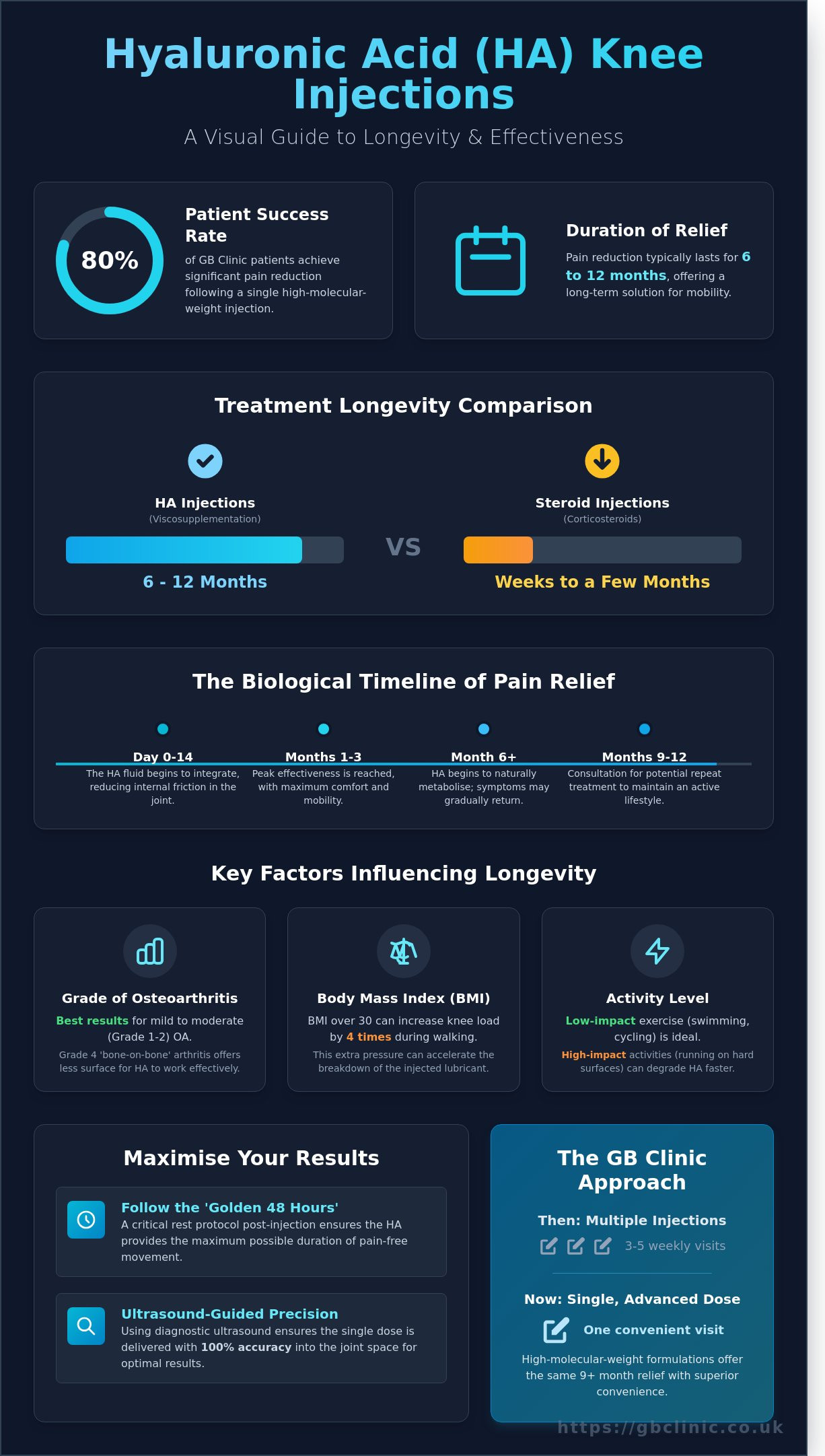
The body processes these injections in distinct stages. During the first 14 days, the joint begins to settle as the fluid reduces internal friction. Between months 1 and 3, patients typically reach peak effectiveness, reporting the highest levels of comfort and mobility. By the 6-month mark, the substance is naturally metabolised by the body, which can lead to a gradual return of symptoms. GB Clinics provides these treatments in a one-stop setup, making it easily accessible from Summertown, Headington, and Kennington.
Single vs. Multiple Injection Courses
Traditional treatments often required 3 to 5 weekly injections to achieve results. However, GB Clinic prefers high-specification, high-molecular-weight single doses for patient convenience. These advanced formulations offer the same 9-month relief potential with the benefit of a single visit. This approach is highly efficient for patients in Faringdon, Eynsham, or Marcham who want to avoid multiple trips. Using diagnostic ultrasound scans ensures the single dose is delivered with 100% accuracy into the joint space. Understanding how long do HA injections for knee last helps patients plan their long-term recovery and maintain an active lifestyle.
Key Factors That Influence How Long Knee HA Injections Last
The duration of relief varies significantly between patients because joint health is highly individual. Several clinical factors dictate how long do HA injections for knee last, ranging from your physical biology to the technical execution of the procedure. For example, a Body Mass Index (BMI) over 30 increases the mechanical load on the knee joint by four times during standard walking. This additional pressure can accelerate the breakdown of the injected lubricant, potentially shortening the window of relief compared to a patient with a lower BMI.
Activity levels also play a vital role. While movement is encouraged, high-impact activities like long-distance running on hard surfaces can degrade the Hyaluronic Acid faster than low-impact exercises such as swimming or cycling. We often find that patients who follow a structured rehabilitation programme see more sustained results. Our clinic is easily accessible from Abingdon, Witney, and central Oxford for those seeking a professional assessment of their joint mechanics.
The Grade of Osteoarthritis
The Kellgren-Lawrence grading system is the gold standard for measuring the severity of osteoarthritis (OA). Patients with Grade 1 or 2 OA (mild to moderate) typically enjoy the most successful outcomes, with many reporting relief for 6 to 9 months. At this stage, there’s still enough natural cartilage to work synergistically with the injection. In contrast, Grade 4 ‘bone-on-bone’ arthritis offers less surface area for the HA to coat, often resulting in shorter relief periods. To determine your current stage, we recommend a diagnostic ultrasound scan to visualise the joint space accurately.
The Importance of Ultrasound Guidance
Precision is the most critical factor in treatment longevity. Traditional ‘blind’ injections, where a clinician relies on touch and landmarks, have a failure rate as high as 20% to 30% regarding accurate intra-articular placement. If the HA is accidentally injected into the fat pad or surrounding soft tissue rather than the joint capsule, it cannot provide the necessary lubrication. Various clinical studies on HA injections demonstrate that ultrasound-guided procedures ensure 100% accuracy. By confirming the needle position in real-time, we ensure the substance reaches the intra-articular space, which lead to superior pain scores and longer-lasting functional improvements. If you’re travelling from Summertown, Headington, or Eynsham, our specialist-led team can help you recover your mobility through these targeted, evidence-based methods.
Comparing Duration: HA Injections vs Steroid Injections for Arthritis
Patients frequently ask how long do HA injections for knee last compared to traditional corticosteroid treatments. The two options serve different clinical purposes. Steroids act as potent anti-inflammatories, offering rapid relief within 24 to 48 hours. However, this effect is often temporary, typically lasting between 4 and 12 weeks. Hyaluronic acid (HA) functions as a lubricant and shock absorber. While it takes longer to become effective, usually 2 to 4 weeks, the relief is significantly more durable, often spanning 6 to 9 months.
- Steroid Onset: 24 to 48 hours for acute pain reduction.
- HA Onset: 2 to 4 weeks for biological integration.
- Steroid Duration: 1 to 3 months of symptom suppression.
- HA Duration: 6 to 9 months of improved joint mechanical function.
Choosing between these treatments depends on the current state of the joint. If a patient presents with high levels of active inflammation, a steroid may be necessary to “cool” the joint first. For chronic wear without significant swelling, HA is often the superior choice for sustained health. GB Clinics provides these specialist assessments for patients across Oxfordshire, ensuring treatments are easily accessible from Abingdon, Summertown, and Kennington.
The Steroid ‘Crash’ vs HA Stability
Corticosteroids follow a “peak and fall” trajectory. Patients often experience a dramatic surge in comfort followed by a sharp decline as the medication metabolises. This can lead to a cycle of pain returning before the next safe injection window. HA provides a more stable, plateau-style of management. It doesn’t just mask pain; it improves the quality of the synovial fluid. Because HA is a natural component of the joint, it’s safer for repeated long-term use. Frequent steroids can occasionally lead to cartilage thinning, whereas HA supports the joint environment. For those in Marcham or Headington suffering from a sudden, painful flare-up, a guided steroid injection remains an excellent tool to regain initial control.
Combining Therapies for Maximum Impact
A multi-modal strategy often yields the most effective results for chronic knee issues. The “Cingal” approach involves a single injection containing both a fast-acting steroid and a high-concentration HA. This provides the immediate relief of a steroid while the HA builds a foundation for long-term comfort. This method is highly effective for medial knee soreness, where mechanical wear often causes secondary inflammation. Our clinics, conveniently located for residents in Witney, Faringdon, Eynsham, and central Oxford, use ultrasound guidance to ensure these combined therapies are delivered with millimetre precision into the joint space.
Practical Tips to Maximise the Duration of Your Knee Injection Results
The longevity of your treatment depends heavily on the care you take in the days and weeks following the procedure. At GB Clinics, we emphasize the ‘Golden 48 Hours’ as the most critical period. During these first two days, you must rest the joint to prevent the Hyaluronic Acid from being displaced or leaking from the joint capsule. Avoid any high-impact activities, heavy lifting, or standing for more than 20 minutes at a time. This resting phase allows the HA to integrate properly with your existing synovial fluid.
Once this initial window passes, low-impact movement is essential for distributing the lubricant. Gentle walking or using a stationary bike on low resistance helps the HA coat the entire articular surface. For our patients in Witney and Abingdon, we recommend a gradual return to movement to ensure the joint remains lubricated without being overstressed. Patients often ask how long do HA injections for knee last, and the clinical reality is that active participation in recovery can extend the benefits by several months.
Weight management is another vital tool for reducing the ‘wear rate’ of the HA. Data shows that every 1kg of weight lost reduces the load on the knee joint by 4kg during daily activities. By reducing this mechanical pressure, the lubricant lasts longer before breaking down. Additionally, strengthening the quadriceps is the best structural support you can provide. A strong quad muscle acts as a natural shock absorber, taking the brunt of the impact during walking and reducing the friction within the joint space.
Post-Injection Rehabilitation
Specific rehabilitation exercises are designed to improve joint mechanics and offload the medial compartment, which is often the area of greatest wear. Our clinicians use manual therapy to prepare the joint, ensuring there is adequate space for the HA to function effectively. You can access these specialist physiotherapy services at our facilities, which are easily accessible from Summertown, Kennington, and Marcham.
Lifestyle Adjustments for Joint Longevity
Footwear choices directly impact knee health. If you suffer from overpronation, where the foot rolls inward, it increases the strain on the inner knee. We advise patients from Headington to Eynsham to use orthotic support or stability shoes to correct this alignment. Hydration is also a key factor. Because synovial fluid is approximately 98% water, drinking 2.5 litres of water daily helps maintain the volume and viscosity of the fluid. When patients ask our Oxford specialists how long do HA injections for knee last, we highlight that a hydrated, well-aligned body provides the best environment for the injection to succeed.
Expert HA Injection Treatment in Oxford: The GB Clinic Approach
GB Clinic provides specialist knee arthritis care focused on your specific mobility goals. Our clinicians use a “One-Stop” model to ensure your recovery begins as quickly as possible. This means you receive your clinical consultation, a diagnostic ultrasound scan, and the actual injection during a single visit. This efficiency reduces the need for multiple trips and speeds up your path to relief. We provide evidence-based treatments that focus on long-term joint health rather than temporary fixes. Patients often ask how long do HA injections for knee last; while individual results vary based on the grade of arthritis, many of our patients experience improved mobility for 6 to 12 months following a single guided procedure. Our commitment to professional care includes offering no-obligation consultations to ensure you feel confident in your treatment choice.
- Consultation: A thorough review of your medical history and physical symptoms.
- Ultrasound Scan: Real-time imaging to assess joint health and ensure needle precision.
- Guided Injection: Precise delivery of Hyaluronic Acid into the joint capsule for maximum efficacy.
Convenient Access Across Oxfordshire
Our Oxford clinic is strategically located for easy access from across the county. We regularly serve patients from Summertown, Headington, and Kennington who require expert MSK interventions. If you’re travelling from Faringdon or Eynsham, the journey typically takes under 30 minutes via the A420 or A40. We offer dedicated on-site parking to ensure your visit is stress-free and accessible even if your mobility is currently limited. Choosing a local specialist in central Oxford ensures you have consistent access to follow-up care and physiotherapy support. This proximity is vital for monitoring how long do HA injections for knee last in your specific case and adjusting your rehabilitation plan accordingly.
Your Path to Pain-Free Movement
Booking your initial MSK assessment is straightforward. You can schedule an appointment through our online portal or by calling our Oxford centre directly. To help us provide the most accurate diagnosis, please bring any previous imaging reports, such as X-rays or MRI results, and a current list of medications to your visit. We’ll perform a thorough physical examination and use ultrasound imaging to confirm the state of your joint tissue. This data-led approach allows us to create a recovery programme that is unique to your lifestyle. Our goal is to get you back to the activities you love without the burden of chronic pain. Use the link below to start your journey.
Take the Next Step Toward Pain-Free Movement
Understanding how long do HA injections for knee last is vital for managing your expectations and long-term recovery. Clinical data shows that most patients experience significant pain relief and improved mobility for 6 to 12 months following a treatment cycle. This duration is often superior to corticosteroid alternatives, which typically provide relief for only 3 to 4 months. At GB Clinics, our expert MSK clinicians use ultrasound-guided techniques to ensure 100% accuracy during the procedure, which maximises the effectiveness of the hyaluronic acid within the joint capsule.
We provide a streamlined, one-stop service at our Oxford clinical centre. It’s easily accessible for patients travelling from Abingdon, Summertown, Kennington, Marcham, Headington, Witney, Faringdon, and Eynsham. You can access advanced diagnostics and evidence-based treatments without the delays often found in traditional healthcare pathways. We offer zero-commitment consultations to help you understand your options and start your journey back to an active lifestyle.
Our team is ready to help you regain your independence and reduce joint discomfort through specialist care. Book a Consultation at GB Clinic Oxford today to discuss a personalised treatment plan. We look forward to supporting your recovery.
Frequently Asked Questions
How many times can I repeat HA injections in my knee?
You can repeat Hyaluronic Acid (HA) injections every 6 months if the initial treatment provided effective relief. Clinical protocols recommend a minimum 26 week gap between courses to maintain optimal joint lubrication. At GB Clinics, we monitor your progress to ensure repeat injections continue to support your mobility.
Approximately 70% of patients find that subsequent injections offer similar or improved results compared to their first treatment. We provide these regular maintenance programmes for patients across Abingdon and Headington who wish to manage chronic osteoarthritis without surgery.
Is there anyone who should not have HA injections for knee pain?
You shouldn’t have HA injections if you have an active skin infection or a joint infection near the injection site. People with known hypersensitivities to hyaluronate preparations should also avoid this treatment. While older versions were derived from avian sources, modern synthetic options used at our clinic are significantly safer for most patients.
Our clinicians in Oxford screen every patient to ensure they don’t fall into the 2% of the population who might experience an adverse reaction. We always prioritise your safety by reviewing your full medical history during your initial consultation.
Can I walk normally immediately after a knee injection?
You can walk normally immediately after the procedure, but you’re advised to avoid strenuous activity for 48 hours. This includes running, lifting heavy weights, or prolonged standing. Resting the joint for these 2 days allows the substance to settle and reduces the risk of post-injection flare-ups.
Patients visiting us from Witney or Eynsham usually find they can drive home comfortably after their appointment. We provide a clear aftercare sheet to ensure you know exactly how to manage the joint in the first 48 hours for the best outcome.
What happens if the HA injection doesn’t last as long as expected?
If you find that how long do HA injections for knee last is shorter than the typical 6 months, we’ll re-evaluate your treatment plan. About 25% of patients with advanced “bone-on-bone” changes may require alternative therapies like PRP or specialised bracing.
Our Oxford-based specialists will assess your joint’s structural condition using diagnostic tools. We may suggest a different concentration or a combined approach to ensure you achieve longer-lasting mobility and comfort.
Are HA injections for the knee available on the NHS or only privately?
HA injections are primarily available privately because the NHS restricted their routine use in 2017 due to cost-effectiveness guidelines. While some local trusts still offer them, waiting lists often exceed 18 weeks. GB Clinics provides immediate access for patients across Kennington and Marcham.
Choosing private treatment ensures you receive high-molecular-weight products that are often unavailable through standard primary care. This “one-stop” setup avoids the delays associated with public health sectors and gets you back to your activities sooner.
How long does the actual injection procedure take at the clinic?
The entire clinical appointment usually takes between 20 and 30 minutes, while the actual injection procedure takes less than 5 minutes. We use ultrasound guidance to ensure 100% accuracy in needle placement, which significantly improves the outcome.
This efficient process is designed to fit into your day, making it easily accessible for those commuting from Summertown or central Oxford. You’ll spend most of the session discussing your symptoms and receiving a thorough physical assessment before the targeted injection.
Will my insurance cover the cost of HA injections in Oxford?
Most major UK health insurers, including Bupa and AXA Health, cover HA injections when they’re part of a specialist-led treatment plan. We recommend checking your specific policy, as 85% of private health plans include provisions for musculoskeletal injections.
Our administrative team helps patients from Faringdon and surrounding areas navigate the authorisation process. We ensure costs are transparently managed and authorised before your session begins to avoid any unexpected expenses.
What is the success rate for HA injections in moderate osteoarthritis?
Clinical data shows an 80% success rate for patients with Grade 2 or Grade 3 moderate osteoarthritis. These individuals typically experience a measurable reduction in stiffness and an increase in walking distance.
Understanding how long do HA injections for knee last is essential for managing expectations; most patients report sustained relief for 6 to 9 months. This evidence-based approach helps restore function and effectively delays the need for surgical intervention for patients in Eynsham and the surrounding Oxford area.