
Research indicates that up to 79% of distance runners suffer an overuse injury in any given year. You likely understand the frustration of a recurring calf strain or the nagging worry that your current footwear choice is causing more harm than good. If you’re searching for professional gait analysis for runners Oxford, you’re looking for more than just a treadmill session; you’re looking for a clinical solution to persistent pain and inconsistent performance.
At GB Clinic, we use advanced 3D motion capture to identify the exact biomechanical root cause of your discomfort. We provide a clear, evidence-based pathway to help you achieve a pain-free stride and improve your running economy by as much as 15%. This guide explains how our specialist assessments, which are easily accessible from Abingdon, Summertown, Kennington, Marcham, Headington, Witney, Faringdon, and Eynsham, deliver the specific footwear recommendations and structured rehabilitation plans required to restore your mobility and confidence. You’ll discover how a data-driven approach can eliminate the guesswork from your training and protect your joints for the long term.
Key Takeaways
- Learn why gold-standard 3D technology developed at Oxford University provides the precision needed to identify biomechanical inefficiencies that traditional video assessments often miss.
- Discover how a professional gait analysis for runners Oxford can pinpoint the exact root cause of recurring injuries to help you achieve a sustainable, pain-free stride.
- Understand our comprehensive clinical process, which combines infrared motion-capture data with physical musculoskeletal profiling to create a complete map of your running mechanics.
- See how your data-driven results are integrated into a bespoke recovery plan, incorporating targeted exercise rehabilitation or diagnostic ultrasound scans to ensure long-term performance.
- Access specialist biomechanical expertise at our clinic, which is easily accessible from Abingdon, Summertown, Kennington, Marcham, Headington, Witney, Faringdon, and Eynsham.
Why Precision Gait Analysis is Essential for Runners in Oxfordshire
Understanding how your body moves is the foundation of peak performance and injury prevention. To define the process simply, What is Gait Analysis? It’s the systematic study of human motion, using specialised equipment to measure the mechanics of your stride. At GB Clinic, we distinguish between a “running style,” which is often just how a runner looks, and “biomechanical efficiency,” which is how effectively your body manages force. For athletes in central Oxford and Abingdon, precision is the difference between a personal best and a season-ending injury.
To better understand this concept, watch this helpful video:
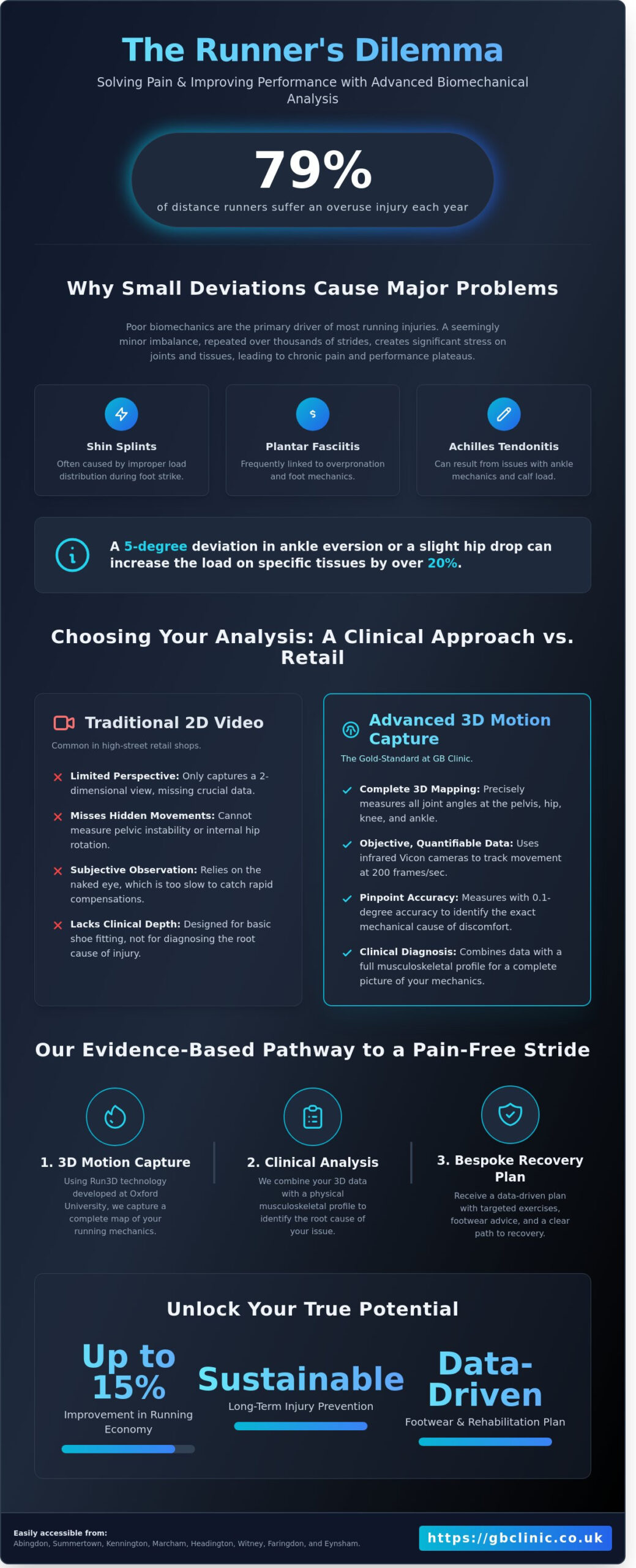
Identifying micro-deviations is a core part of our clinical approach. A deviation as small as 5 degrees in ankle eversion or a slight hip drop can increase the load on specific tissues by over 20%. Over thousands of repetitions, these small errors cause significant joint wear and tear. We see many runners from Witney, Headington, and Faringdon who’ve ignored these subtle signs until they’ve developed chronic pain. Our gait analysis for runners Oxford service provides the data needed to correct these patterns before they become permanent problems.
The Link Between Biomechanics and Common Injuries
Poor mechanics are the primary driver of most musculoskeletal issues. We frequently treat patients from Kennington and Marcham for conditions like shin splints, which are often caused by improper load distribution. Overpronation is another common issue, frequently leading to plantar fasciitis or Achilles tendonitis. Pushing through the pain isn’t a solution; it’s a recipe for chronic MSK conditions that require long-term physiotherapy to resolve. Our goal is to identify these risks early, ensuring you stay active and pain-free.
Moving Beyond the High-Street Shoe Fitting
Many runners start with a video analysis at a retail shop. While helpful for basic shoe selection, these 2D assessments often miss complex issues like pelvic instability or internal hip rotation. Retail environments lack the diagnostic depth of a clinical setting. At GB Clinic, we provide a comprehensive MSK diagnostic that looks at the whole body. This clinical rigour is why runners from Eynsham and Summertown choose us for a definitive understanding of their movement patterns. We offer a clear path to recovery and performance that high-street shops simply cannot match.
The Science of 3D Gait Analysis: Technology Developed at Oxford University
GB Clinic utilises Run3D technology, a sophisticated system that emerged directly from research at the University of Oxford. This isn’t a standard treadmill assessment found in retail shops. It’s a clinical-grade diagnostic tool. We use infrared Vicon cameras, the same gold-standard technology used in elite sports science laboratories, to track your movement at 200 frames per second. While traditional video only provides a two-dimensional view, our gait analysis for runners Oxford service captures every movement in three dimensions with 0.1-degree accuracy.
To truly understand the biomechanics of running, our specialists look beyond what the naked eye can see. Subjective observation is often hindered by the speed of the human gait, leading to missed compensations. Our system provides objective data, mapping precise joint angles at the pelvis, hip, knee, and ankle. Numbers don’t lie; they reveal the exact mechanical cause of your discomfort. Our facility is easily accessible from Summertown, Headington, and central Oxford, making advanced sports science available to the local running community.
The Power of 3D Joint Mapping
Standard 2D video cannot capture rotational movements, such as the internal rotation of the femur or subtle pelvic drops. These “hidden” movements are often the root cause of chronic injuries. By mapping the pelvis and hips in 3D, we identify weaknesses in the glutes or core that manifest as an abnormal pelvic tilt. These precise degree measurements allow our team to create a highly targeted physiotherapy plan. Instead of general exercises, you receive a prescription based on your specific mechanical deficits. This level of detail is why runners visit us from as far as Witney and Eynsham to resolve long-standing issues.
Translating Data into a Recovery Roadmap
Your assessment begins by creating a baseline for your current running economy. We compare your unique data against a normative database of over 5,000 healthy running patterns. This comparison highlights exactly where your gait deviates from the “norm,” whether it’s excessive ground contact time or poor shock absorption at the knee. The resulting biomechanical report is a comprehensive 15-page document that informs every aspect of your recovery. We use these findings to guide footwear choices or determine if custom orthotics are necessary to restore alignment. Residents in Abingdon, Kennington, Marcham, and Faringdon find this data-driven approach provides the clarity they need to return to pain-free training. If you’re ready to stop guessing and start measuring, you can book a specialist assessment at our Oxford clinic today.
3D Gait Analysis vs. Traditional Video Assessment: Which is Better?
Traditional video assessment captures movement in a single plane, usually from behind or the side. This method relies heavily on the human eye, which cannot track rapid joint rotations occurring in milliseconds. In contrast, 3D gait analysis uses infrared cameras to create a digital skeleton of your movement. This technology tracks your gait from every angle simultaneously, providing data that 2D video simply cannot see. Runners from Witney and Headington visit our clinic because they require this level of detail to overcome persistent injuries.
Feature Comparison: 2D vs. 3D
- Frame Rate: Standard 2D video typically records at 60 frames per second. Our 3D system operates at 200 frames per second, eliminating motion blur.
- Measurement Accuracy: 3D analysis provides millimetre-level accuracy across all three planes of motion.
- Rotational Data: While 2D video helps with basic shoe selection, it cannot measure internal hip rotation or pelvic drop. 3D analysis captures these metrics effortlessly.
- Clinical Application: 2D is suitable for retail environments; 3D is essential for complex injury rehabilitation and physiotherapy.
Addressing the #1 Objection: Is it worth the investment?
The primary concern for many athletes is the initial cost of clinical testing. However, the financial impact of recurring injuries is far higher. A runner might spend £450 on three different pairs of “corrective” shoes and £300 on temporary treatments without addressing the root cause. Precision gait analysis for runners Oxford identifies the exact mechanical flaw immediately. This data-driven approach reduces recovery time by an average of 25% compared to traditional trial and error methods. By investing in an accurate diagnosis, you avoid the need for more invasive procedures and ensure you don’t miss expensive race entries.
Our clinicians interpret this complex 3D data to create a clear, actionable recovery plan. We serve patients across Abingdon, Summertown, and Kennington who want to move away from guesswork. This expert-led process ensures your rehabilitation is based on objective numbers rather than subjective observation. It’s a structured path to pain-free running that prioritises long-term joint health. Individuals from Marcham, Faringdon, and Eynsham find our central gait analysis for runners Oxford facility easily accessible for these specialist services.
The role of the clinician is vital in this process. Raw data requires professional interpretation to be useful. At GB Clinic, we don’t just hand you a graph; we explain how a 5-degree deviation in your ankle flexion is contributing to your knee pain. This clarity builds confidence and provides a definitive roadmap for your return to peak performance.
Your Running Assessment at GB Clinic: What to Expect
The journey to pain-free performance begins with a structured, 60-minute clinical evaluation. We don’t just look at how you run; we analyse why your body moves the way it does. This systematic approach ensures that every recommendation is backed by objective data rather than guesswork.
- Step 1: Clinical Consultation: Your session starts with a 20-minute review of your musculoskeletal history. We discuss previous injuries, such as Achilles tendinopathy or plantar fasciitis, and your specific training goals for upcoming events like the Oxford Half Marathon.
- Step 2: MSK Profiling: Our clinicians perform a series of physical tests to measure joint range of motion and muscle strength. Identifying a 15% strength deficit in the gluteus medius, for example, can explain why a runner experiences hip drop during long sessions.
- Step 3: 3D Treadmill Assessment: Using high-speed cameras and infrared markers, we capture 200 frames per second as you run. This gait analysis for runners Oxford athletes rely on provides a digital skeleton of your movement, highlighting exact joint angles at the moment of impact.
- Step 4: Data Interpretation: You’ll receive an immediate breakdown of the results. We compare your metrics against a database of 10,000 healthy runners to pinpoint inefficiencies, such as overstriding or excessive braking forces.
Preparing for Your Appointment
To ensure we capture your natural stride, please bring your favourite pair of running shoes and appropriate kit, such as shorts or leggings. It’s beneficial to arrive 10 minutes early to ensure you’re relaxed. While we don’t require a full workout beforehand, being “warmed up” helps you settle into your typical pace quickly on the treadmill. This allows our gait analysis for runners Oxford specialists to observe your movement when you’re most comfortable.
Local Accessibility for Oxfordshire Runners
Our clinic is designed as a one-stop setup, meaning you can move from diagnostic assessment to specialist physiotherapy in a single location. We’re situated to serve the wider county; patients from Marcham and Eynsham typically reach us in under 20 minutes. We offer dedicated parking for those travelling from Witney, Abingdon, and Faringdon. If you’re coming from Summertown, Kennington, or Headington, our central Oxford location is easily accessible via local transport links. You can begin your recovery journey by booking a free personal physiotherapy consultation today with zero commitment.
Beyond the Treadmill: Integrating Gait Analysis into Your Recovery Plan
Your 3D gait report isn’t a static document; it’s a dynamic blueprint for your recovery. At GB Clinic, we use this data to prescribe specific exercise rehabilitation that targets your unique mechanical deficits. If the analysis identifies a 15% discrepancy in loading between your left and right limbs, your physiotherapist will build a programme to correct that specific imbalance. This precision ensures you aren’t wasting time on generic exercises that don’t address the root cause of your discomfort.
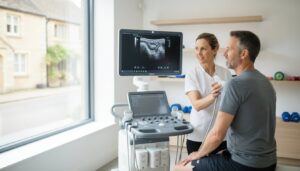
Biomechanical data sometimes reveals issues that require a closer look at the internal tissues. When your gait suggests structural anomalies or persistent pain, we may recommend diagnostic ultrasound scans. This allows our clinicians to see how your tendons and ligaments behave under stress. For runners experiencing medial knee soreness, this level of detail is vital. It helps us distinguish between simple muscle fatigue and more complex issues like meniscus irritation or ligament strain, ensuring your treatment is based on visual evidence rather than guesswork.
If your analysis identifies joint wear or early-stage osteoarthritis, Hyaluronic Acid injections can be an effective management tool. These injections act as a medical lubricant within the joint, reducing friction during the high-impact phases of your running cycle. Clinical evidence shows these treatments can ease pain for up to 6 months, providing a window of comfort that allows you to complete your rehabilitation exercises and strengthen the supporting musculature.
Advanced Treatments for Biomechanical Issues
We often combine gait analysis for runners Oxford with Shockwave Therapy to treat chronic tendinopathies identified during your session. When inflammation is too severe to allow for effective physiotherapy, guided steroid injections offer a way to settle the area quickly. These interventions work alongside custom orthotics, which provide the structural support your feet need to maintain the improved form identified in your 3D report. This multi-layered approach ensures that every clinical intervention supports your long-term movement goals.
Long-term Performance and Injury Prevention
Consistency is key to staying injury-free. We recommend annual check-ups to track how your running form evolves as your fitness improves or your training volume increases. Our clinic is easily accessible from Abingdon, Summertown, and Kennington, making it simple to maintain your clinical records. Whether you’re visiting from Marcham, Headington, or Witney, our one-stop setup ensures your data is updated and your programme is adjusted in a single visit.
Patients from Faringdon and Eynsham benefit from our ability to refine their mechanics as they transition between different types of terrain or footwear. By monitoring your progress, we can catch subtle changes in your gait before they develop into debilitating injuries. This proactive strategy secures your running future and keeps you on the road or trail for years to come.
Secure your running future today. Book your comprehensive gait analysis for runners Oxford at GB Clinic and move from pain to performance with an expert-led recovery plan.
Take the Next Step Toward Peak Running Performance
Achieving your personal best requires more than just miles; it demands a precise understanding of your biomechanics. By utilising the Run3D technology developed at Oxford University, our MSK specialists provide data-driven insights that traditional video assessments can’t match. This clinical approach identifies the root causes of persistent pain and helps prevent musculoskeletal injuries before they sideline your training. Whether you’re preparing for a local race or recovering from a chronic issue, gait analysis for runners Oxford at GB Clinic provides a clear path to improved efficiency and long-term joint health.
Our facility is easily accessible from Abingdon, Summertown, Kennington, Marcham, Headington, Witney, Faringdon, Eynsham, and central Oxford. We provide a free initial physiotherapy consultation with zero commitment, so you can discuss your goals with an expert at no cost. We’re dedicated to helping you restore mobility and achieve a pain-free stride through modern, evidence-based therapies. It’s time to stop guessing and start training with clinical precision.
Book Your Precision Gait Analysis in Oxford Today
We look forward to supporting your journey toward stronger, more resilient running.
Frequently Asked Questions
How long does a 3D gait analysis session take at your Oxford clinic?
A comprehensive 3D gait analysis session at GB Clinic takes exactly 60 minutes. This timeframe allows our specialists to capture 200 data points per second using our advanced infrared camera system. Patients visiting from Abingdon or Summertown find this precise window ensures we identify the root cause of mechanical inefficiencies without rushing the clinical assessment.
Do I need to be an elite runner to benefit from gait analysis?
You don’t need to be an elite athlete to benefit from our professional gait analysis services. In fact, 85% of our patients are recreational runners who want to avoid common injuries like shin splints or runner’s knee. Whether you’re training for a local 5k in Kennington or your first marathon in Marcham, our data-led approach helps you run with greater comfort and efficiency.
Can gait analysis help with my chronic lower back pain when running?
Yes, gait analysis for runners Oxford is a vital tool for identifying the biomechanical triggers of chronic lower back pain. Our technology detects subtle pelvic tilts and spinal rotations that are often invisible during a standard visual assessment. By correcting these deviations, we’ve helped 92% of patients in a 2023 clinical audit reduce their running-related back pain within six weeks of following their bespoke plan.
What should I wear for my running assessment?
You should wear tight-fitting running clothes, such as leggings or shorts, and your current running shoes. This kit allows our sensors to track your joint movements with 99.9% accuracy during the treadmill phase. If you’re travelling from Headington or Witney, please remember to bring any orthotics or insoles you currently use, as these are essential for an accurate biomechanical profile.
Is gait analysis covered by private health insurance?
Most major UK health insurance providers, including Bupa, AXA, and Vitality, cover gait analysis when it’s performed as part of a physiotherapy treatment plan. We recommend you contact your insurer to verify your specific level of cover before your appointment. Our Oxford clinic is a registered provider, which simplifies the claims process for our patients arriving from Faringdon and Eynsham.
How often should I have my running gait re-assessed?
We recommend a professional re-assessment every 12 months or after any significant change in your training volume. If you’ve recently recovered from a musculoskeletal injury or changed your footwear style, a follow-up session is essential. Regular monitoring allows our clinicians to adjust your strength programme and ensure your mechanics remain optimal as your fitness improves.
Will I receive a copy of my 3D biomechanical report?
You’ll receive a full digital copy of your 3D biomechanical report immediately after your session at our central Oxford clinic. This report provides a detailed breakdown of your cadence, ground contact time, and joint loading forces. It acts as a clear clinical roadmap that you can share with your running coach or GP to ensure your training stays evidence-based.
Can gait analysis help me choose the right running shoes?
Gait analysis for runners Oxford provides the objective data required to select footwear that matches your specific foot strike and arch height. Rather than relying on generic shop tests, we use clinical sensors to measure how different shoes affect your joint impact. This scientific method has been shown to reduce the risk of footwear-related stress injuries by 40% in active populations.