
Living with persistent joint pain can be challenging, and navigating the complex world of treatment options often adds to the uncertainty. When faced with choices like steroid injections, Hyaluronic Acid, or the more advanced prp injections, it is natural to feel unsure about which path is best for your specific condition. Concerns about effectiveness, recovery time, and cost are valid and require clear, expert-led answers to help you move forward with confidence.
This focus on leveraging the body’s own systems is a cornerstone of modern integrative medicine. For those dealing with complex chronic conditions that may also involve joint pain, such as Lyme disease or autoimmune disorders, specialized centers such as IAH Wellness offer advanced immunotherapy and other integrative treatments.
The effectiveness of Platelet-rich plasma (PRP) lies in its ability to amplify the body’s natural repair mechanisms. When platelets are activated at a site of injury, they release hundreds of growth factors. These proteins act as powerful signals, instructing local cells to begin regenerating tissue, forming new blood vessels, and reducing inflammation. This process essentially re-starts and boosts the healing cascade, which is particularly beneficial for chronic conditions where the natural healing process has stalled. This principle of using the body’s own components for healing is fundamental to regenerative medicine, and you can discover more about Stem cell therapy to explore another advanced application.
This patient guide is designed to provide that clarity. We will demystify Platelet-Rich Plasma (PRP) therapy, explaining precisely how this regenerative treatment utilises your body’s own natural healing factors to reduce pain and repair damaged tissue. We will compare PRP directly to other established injection treatments, outlining the distinct benefits and considerations for each. Our aim is to provide you with the knowledge to make an informed decision about your musculoskeletal health and find a long-term solution for improved mobility and comfort.
Key Takeaways
- Learn how Platelet-Rich Plasma (PRP) therapy utilises your own blood to stimulate the body’s natural healing processes in injured joints and tissues.
- Understand the key differences between PRP, Hyaluronic Acid, and steroid injections to help you make an informed decision about your joint pain treatment.
- Discover what makes a suitable candidate for prp injections, as a thorough clinical assessment is the essential first step for any treatment plan.
- Gain a clear overview of the treatment journey, from initial consultation to post-injection care, so you know exactly what to expect.
What Are PRP Injections and How Do They Work?
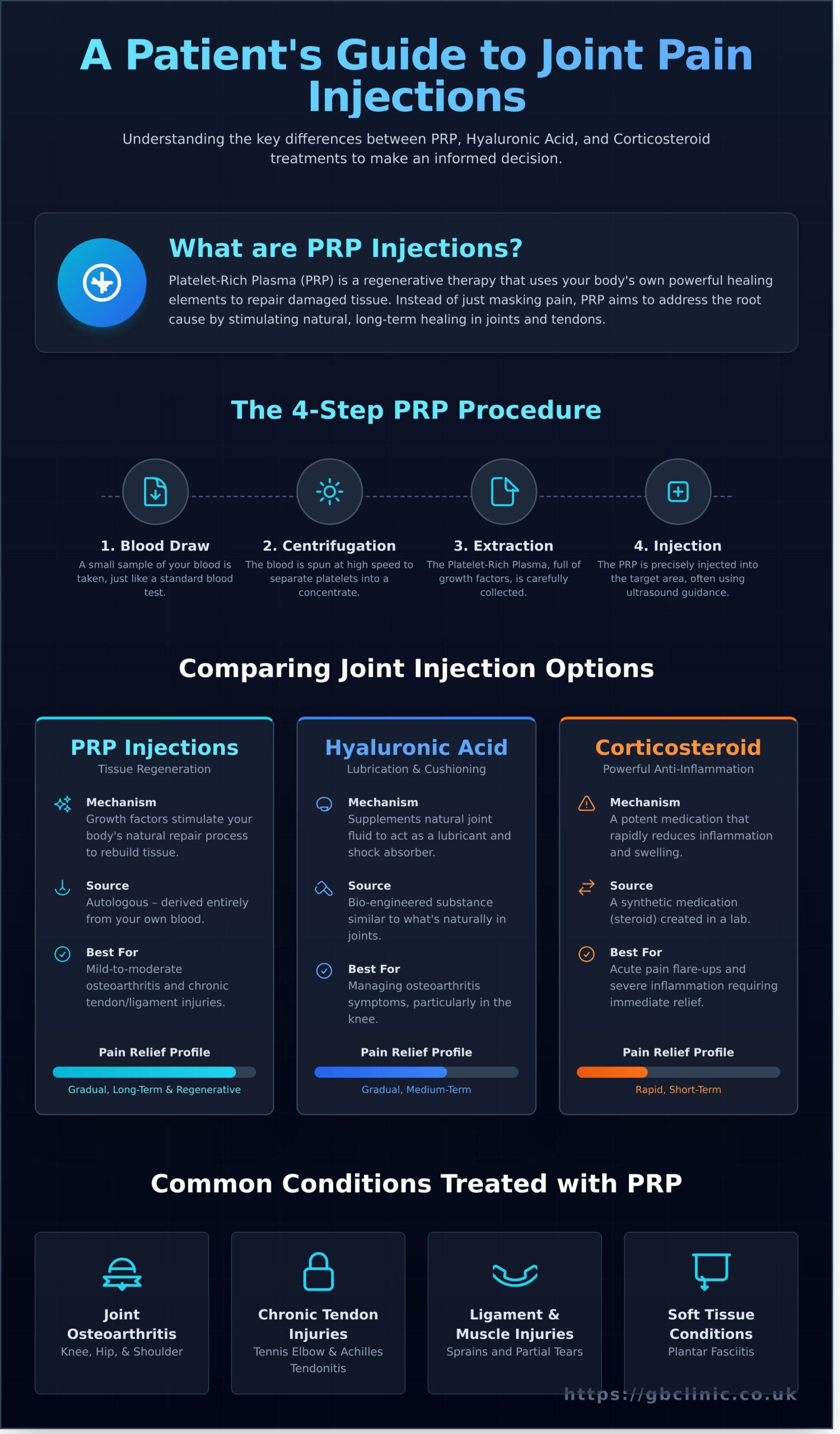
Platelet-Rich Plasma (PRP) therapy is a modern regenerative treatment designed to harness your body’s own healing abilities to repair damaged tissues. Unlike treatments that simply manage symptoms, the goal of prp injections is to stimulate genuine, long-term tissue repair. The procedure uses a concentrated solution derived entirely from your own blood, making it a safe and natural approach to reducing pain and restoring function.
The treatment is based on a simple principle: your blood contains platelets, which are cell fragments rich in powerful proteins called growth factors. By isolating and concentrating these platelets in plasma, we create a potent healing solution. When this is injected into an injured area like an osteoarthritic knee, it provides the building blocks needed to accelerate recovery and address the root cause of the pain, not just mask it.
The Science Behind Regenerative Healing
The effectiveness of Platelet-rich plasma (PRP) lies in its ability to amplify the body’s natural repair mechanisms. When platelets are activated at a site of injury, they release hundreds of growth factors. These proteins act as powerful signals, instructing local cells to begin regenerating tissue, forming new blood vessels, and reducing inflammation. This process essentially re-starts and boosts the healing cascade, which is particularly beneficial for chronic conditions where the natural healing process has stalled.
The PRP Procedure: A Step-by-Step Patient Walkthrough
The procedure is straightforward, safe, and typically completed within a single appointment. It involves four key steps:
- Step 1: Blood Draw
A small sample of your blood is drawn, similar to a standard blood test. - Step 2: Centrifugation
The blood sample is placed in a centrifuge, a machine that spins at high speed to separate the blood into its distinct components: red blood cells, platelet-poor plasma, and platelet-rich plasma. - Step 3: Extraction
The concentrated layer of platelet-rich plasma, which contains 3-5 times the normal concentration of growth factors, is carefully extracted. - Step 4: Precise Injection
The prepared PRP is then precisely injected into the target area, often using ultrasound guidance for accuracy to ensure it reaches the exact point of injury.
Common Conditions Treated with PRP Injections
PRP therapy is a versatile treatment used across a range of musculoskeletal conditions to promote healing and reduce pain. Its applications include:
- Joint Osteoarthritis: Particularly effective for the knee, hip, and shoulder joints.
- Chronic Tendon Injuries: Such as tennis elbow, golfer’s elbow, and Achilles tendonitis.
- Ligament and Muscle Injuries: Including sprains and partial tears.
- Soft Tissue Conditions: Such as plantar fasciitis.
Comparing Your Options: PRP vs. Hyaluronic Acid vs. Steroid Injections
When managing knee osteoarthritis pain, several therapeutic injections are available. Understanding the differences between them is the first step towards making an informed decision with your clinician. The ‘best’ treatment is not universal; it depends entirely on your specific condition, the severity of your symptoms, and your long-term goals for pain relief and function.
Below, we outline the three primary injection therapies to help you understand how they work and which might be most suitable for you.
PRP Injections: For Tissue Regeneration and Healing
Platelet-Rich Plasma (PRP) therapy uses a concentration of your own blood platelets to accelerate healing. The primary mechanism involves stimulating your body’s natural repair processes to regenerate damaged tissue and reduce inflammation. Understanding how PRP injections work reveals their potential for addressing the root cause of pain. This treatment is often recommended for patients with mild-to-moderate osteoarthritis or chronic tendon injuries, aiming for long-term functional improvement rather than just temporary symptom relief.
Hyaluronic Acid (HA) Injections: For Lubrication and Cushioning
Hyaluronic acid is a natural substance found in the synovial fluid of your joints. In osteoarthritis, this fluid thins and becomes less effective. HA injections supplement this fluid, acting as a lubricant and shock absorber to reduce pain and improve joint movement. This approach is primarily used for managing osteoarthritis symptoms, particularly in the knee, with the goal of providing sustained pain relief and enhancing mobility. Learn more about our HA treatments.
Corticosteroid Injections: For Powerful Anti-Inflammation
Corticosteroids are potent anti-inflammatory medications that deliver rapid pain relief by reducing swelling and inflammation within the joint. They are most effective for managing acute flare-ups of inflammatory conditions like arthritis or bursitis. The primary goal of a steroid injection is fast, short-term relief to break a cycle of pain and allow for participation in physiotherapy. See how guided steroid injections ensure precise delivery for maximum effect.
| Feature | PRP Injections | Hyaluronic Acid (HA) | Corticosteroid |
|---|---|---|---|
| Primary Goal | Long-term healing & tissue repair | Pain relief & joint lubrication | Fast, short-term pain relief |
| Mechanism | Stimulates body’s own growth factors | Supplements natural joint fluid | Strong anti-inflammatory action |
| Best For | Mild-to-moderate osteoarthritis, chronic tendon issues | Mild-to-moderate knee osteoarthritis pain | Acute inflammatory flare-ups |
| Onset of Relief | Gradual (several weeks) | Gradual (over a few weeks) | Rapid (24-72 hours) |
| Duration of Effect | 6-12 months or longer | Up to 6 months | A few weeks to a few months |
Are You a Suitable Candidate for PRP Therapy?
Platelet-Rich Plasma (PRP) therapy is a modern, effective treatment for joint and tendon pain, but it is not a one-size-fits-all solution. Determining your suitability is the most important first step. At GB Clinic, every treatment plan begins with a thorough consultation and accurate diagnosis to ensure the recommended therapy aligns perfectly with your specific condition, health status, and recovery goals. Our personalised approach ensures you receive the most appropriate and effective care.
Who Benefits Most from PRP Injections?
While each case is unique, certain individuals typically experience the most significant benefits from prp injections. The latest research on PRP therapy continues to highlight its efficacy in patients who:
- Have mild-to-moderate knee osteoarthritis and are seeking an alternative to surgery.
- Suffer from chronic tendon injuries, such as tennis elbow or Achilles tendinopathy, that have not responded to conventional treatments.
- Are active individuals aiming to accelerate the healing of sports-related injuries like ligament sprains or muscle tears.
- Prefer a regenerative approach that uses their body’s own powerful healing resources to repair damaged tissue.
When PRP Might Not Be the Right Choice
Patient safety and treatment efficacy are our highest priorities. Therefore, PRP therapy is not recommended for individuals with certain medical conditions. Key contraindications include:
- Active local or systemic infections.
- Certain blood disorders, such as platelet dysfunction syndromes or thrombocytopenia.
- A history of cancer in the treatment area.
Furthermore, patients with severe, “bone-on-bone” osteoarthritis may find that other treatments offer more substantial relief. Our clinicians will also consider your overall health and lifestyle factors during your assessment.
The Importance of an Expert MSK Consultation
An accurate diagnosis is the cornerstone of a successful outcome. During your consultation at GB Clinic, our specialist will conduct a comprehensive physical assessment, often aided by a high-resolution diagnostic ultrasound scan. This allows us to visualise the affected tissues in real-time, identify the precise root cause of your pain, and determine the severity of the condition. This detailed evaluation informs a bespoke treatment plan, which may involve prp injections, specialist physiotherapy, or a carefully integrated combination of therapies designed to restore function and reduce pain effectively.
What to Expect: Your PRP Treatment Journey
Understanding the treatment process is a vital part of a successful outcome. At GB Clinics, we ensure every patient is fully informed and comfortable at each stage. Our patient-centric approach means we manage your care with professionalism and clarity, from initial preparation through to your full recovery.
Before Your Appointment
To ensure the best possible results from your treatment, we provide clear pre-procedure guidance. Preparation is straightforward and focuses on creating the optimal conditions for your body to heal.
- Medication Review: You will be advised to stop taking anti-inflammatory medications (NSAIDs) such as ibuprofen for approximately one week before your appointment, as they can interfere with the treatment’s effectiveness. Your clinician will provide precise instructions based on your medical history.
- Stay Well-Hydrated: We recommend drinking plenty of water in the 24 hours prior to your visit. Good hydration makes the blood draw process easier and can enhance the quality of the platelet-rich plasma.
- Final Consultation: Your appointment includes time to ask any final questions. We believe a fully informed patient is an empowered one, and our specialists are here to address all your concerns.
During and Immediately After the Injection
The entire procedure is efficient and designed for your comfort. A small sample of your blood is taken and placed in a centrifuge to concentrate the platelets. This plasma is then precisely injected into the knee joint using ultrasound guidance for accuracy. The appointment typically lasts less than an hour. A local anaesthetic is often used to numb the area and minimise any discomfort during the injection. It is normal to experience some mild soreness, fullness, or swelling at the injection site afterwards. Your clinician will provide specific instructions on initial rest and activity modification for the first few days.
Recovery and Timeline for Results
Patience is key following PRP injections, as the therapy works by stimulating your body’s natural, gradual healing processes. Results are not immediate. The initial recovery phase involves a short period of rest, followed by a gradual and guided return to normal activities. Most patients begin to notice a significant reduction in pain and improvement in function within 4 to 6 weeks, with these benefits often continuing to build for up to six months. To achieve the best long-term outcome, your treatment is supported by follow-up appointments and a tailored physiotherapy programme designed to restore strength and mobility. A structured rehabilitation plan is essential for maximising the regenerative effects of your treatment. To learn more about our comprehensive approach to knee osteoarthritis, please contact our team.
Your Next Step Towards Musculoskeletal Recovery
Navigating your treatment options for joint pain and soft tissue injuries is a significant step. As we’ve explored, Platelet-Rich Plasma therapy offers a regenerative approach, harnessing your body’s natural healing capabilities to repair damaged tissue. Unlike treatments that may only manage symptoms, prp injections are designed to address the underlying cause of your discomfort, providing a pathway to lasting relief and improved function.
Making an informed decision is paramount. At GB Clinics, our expert musculoskeletal specialists are dedicated to creating a personalised treatment plan tailored to your specific condition. We believe in an integrated approach, often combining advanced injection therapies with specialist physiotherapy. To ensure the best possible outcome, all our procedures are performed as ultrasound-guided injections for maximum precision and effectiveness.
If you are ready to determine the most suitable path for your recovery, we invite you to book a consultation to discuss your injection options in Oxford. Your journey towards a more active, pain-free life begins with expert guidance.
Frequently Asked Questions About PRP Therapy
How painful are PRP injections?
Patient comfort is our priority during any procedure. A local anaesthetic is used to numb the area, significantly minimising discomfort. Most patients report feeling a sensation of pressure rather than sharp pain, similar to a standard blood draw or vaccination. Our highly experienced clinicians perform all injections using ultrasound guidance for precision, ensuring the procedure is as quick and comfortable as possible. Any post-injection soreness is typically mild and resolves within a few days.
Are there any risks or side effects with PRP therapy?
PRP therapy is considered a very safe treatment because it uses your own blood, which minimises the risk of allergic reactions or disease transmission. The most common side effects are temporary and localised to the injection site, including mild pain, swelling, or bruising. As with any injection, there is a very small risk of infection. At our clinic, we adhere to strict sterile protocols to ensure patient safety and reduce these risks to an absolute minimum.
How many PRP injections will I need and how often?
The optimal number and frequency of injections are tailored to your specific condition and clinical needs. For knee osteoarthritis, a course of one to three injections is often recommended, with each session spaced approximately two to four weeks apart. During your initial consultation, our specialist will conduct a thorough assessment, including a diagnostic ultrasound scan if necessary, to create a personalised treatment plan that offers the best potential for pain relief and improved function for you.
How long do the results of a PRP injection last?
The longevity of results from PRP injections can vary depending on the individual and the severity of the osteoarthritis. Many patients experience significant pain relief and improved knee function for six months to over a year. The goal of PRP is to stimulate the body’s natural healing processes, leading to long-term tissue repair rather than just temporary symptom masking. A follow-up plan, which may include a top-up injection, can be discussed to maintain the benefits.
Are PRP injections covered by private health insurance in the UK?
In the United Kingdom, coverage for PRP therapy varies significantly between private health insurance providers. Currently, most major insurers do not cover the cost of PRP as a standard procedure for osteoarthritis. We strongly advise you to contact your insurance provider directly and inquire about your specific policy details before beginning treatment. Our administrative team can provide you with the necessary information to assist with your enquiry and help you understand your coverage.
Can PRP be combined with other treatments like physiotherapy for better results?
Absolutely. We find that combining treatments often yields the most effective and lasting outcomes. A course of prp injections can significantly reduce pain and inflammation, creating an optimal window for you to engage more effectively with physiotherapy. A targeted physiotherapy programme will help strengthen the muscles supporting the knee joint, improve flexibility, and restore proper biomechanics. This integrated approach helps to maximise the healing benefits of the PRP and supports long-term recovery and function.