
The most common mistake runners make when facing knee pain isn’t overtraining; it’s assuming that total rest is the only path to recovery. You’ve likely felt that sharp frustration when a run through Headington or Central Oxford is cut short by a familiar ache, leaving you worried that your joints are permanently wearing down. We understand the confusion between needing rest and needing movement is a significant barrier to your training. This guide provides a structured approach to runner’s knee rehabilitation exercises that focuses on kinetic chain recalibration rather than just masking the symptoms.
Whether you’re training in Abingdon, Witney, or Summertown, you’ll master the exact exercise progression required to return to the roads of Oxfordshire pain-free. We’ll explore why addressing hip and gluteal stability is the key to long-term relief and how to identify when clinical interventions like shockwave therapy or diagnostic ultrasound scans are necessary. From Didcot to Eynsham, and across Farmoor, Marcham, Kennington, or West Oxford, you’ll gain a clear, phased plan to restore your mobility. We’ll also detail how our free 15 minute consultation can help you stop guessing and start a professional recovery journey today.
Key Takeaways
- Identify whether your pain stems from Patellofemoral Pain Syndrome or ITB Syndrome to ensure your recovery plan targets the correct biomechanical trigger.
- Master a phased progression of runner’s knee rehabilitation exercises that moves from initial irritation to advanced eccentric loading for long-term resilience.
- Explore advanced non-surgical options like Hyaluronic Acid injections, proven to ease pain for up to 6 months, for cases that don’t respond to movement alone.
- Access expert care and diagnostic ultrasound scans, starting with a free 15 minute consultation, at our facilities serving Abingdon, Witney, Didcot, and Faringdon.
- Benefit from a streamlined recovery path available to runners in Summertown, Headington, Kennington, Marcham, Farmoor, Eynsham, and throughout Central and West Oxford.
Defining Runner’s Knee: Patellofemoral Pain vs. ITB Syndrome
Many athletes across Central Oxford and Headington use “runner’s knee” as a catch-all label for any discomfort near the joint. In reality, it’s an umbrella term that usually refers to two distinct biomechanical issues. Distinguishing between them is the first step toward choosing the correct runner’s knee rehabilitation exercises. Getting this diagnosis wrong often leads to wasted time and unnecessary sessions that don’t address the root cause of your discomfort. Professional sports physiotherapy in Oxford typically costs between £55 and £85 per session as of April 2026; therefore, an accurate initial assessment is a vital investment in your recovery.
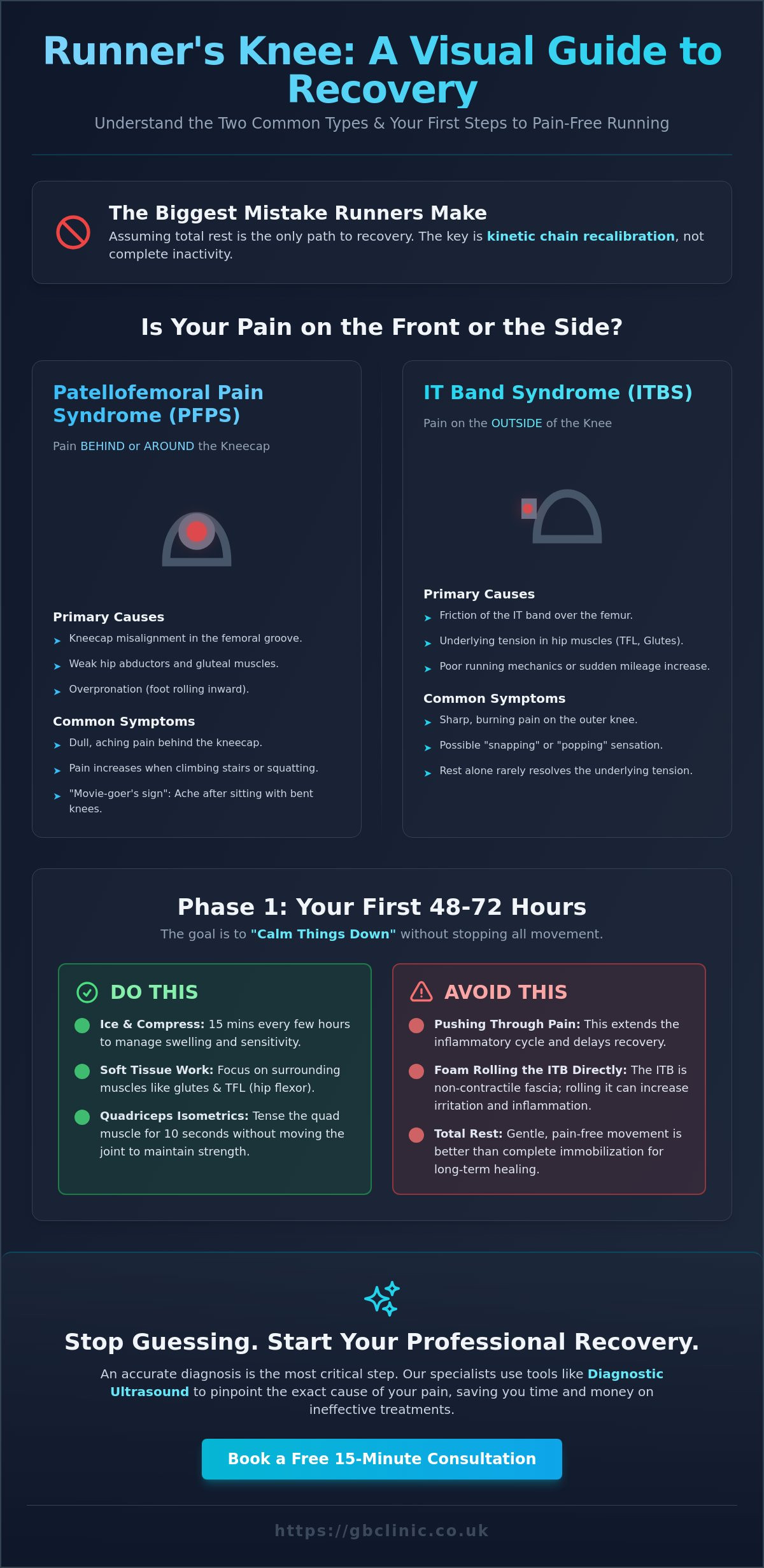
Patellofemoral Pain Syndrome is a misalignment of the kneecap within the femoral groove during repetitive loading. This condition, clinically known as Patellofemoral Pain Syndrome, typically stems from biomechanical triggers like overpronation at the foot or significant weakness in the hip abductors. When these muscles don’t support the leg properly, the kneecap tracks incorrectly, causing irritation to the underlying cartilage. Whether you’re running in Abingdon or training in Witney, a professional assessment can pinpoint these specific movement patterns before they lead to chronic injury.
To better understand this concept, watch this helpful video:
Symptoms of Patellofemoral Pain (Anterior)
This version of runner’s knee presents as a dull, aching pain behind or around the kneecap. It’s particularly noticeable when you’re climbing stairs in Summertown or sitting for long periods in a car or office in Didcot. Clinical specialists often look for the “movie-goer’s sign,” which is a noticeable stiffness or ache after sitting with knees bent in tight spaces. For athletes in Kennington or Marcham, we utilize diagnostic ultrasound scans to rule out other structural damage, ensuring your runner’s knee rehabilitation exercises are built on accurate data rather than guesswork.
Symptoms of ITB Syndrome (Lateral)
Iliotibial Band (ITB) Syndrome is different because the pain is localized on the outside of the knee joint. Runners in West Oxford or Eynsham often describe a “snapping” sensation as the thick band of tissue slides over the bony protrusion on the side of the knee. Unlike anterior pain, rest alone rarely fixes ITB issues because the underlying tension in the hip remains. It requires targeted myofascial release and specific loading strategies to address the friction. If you’re based in Farmoor or Faringdon, identifying this lateral pain early prevents it from becoming a long-term obstacle to your training season.
Phase 1: Immediate Relief and Mobility Exercises
The initial stage of recovery follows a “Calm Things Down” philosophy. This approach focuses on reducing acute irritation for a period of 48 to 72 hours before you attempt more demanding runner’s knee rehabilitation exercises. Many athletes in Central Oxford or West Oxford make the mistake of pushing through the pain, which only extends the inflammatory cycle. Instead, prioritize rest and targeted management. If you’ve been tackling the hilly trails near Faringdon or the Ridgeway near Didcot, use ice and compression for 15 minutes every few hours to control swelling and sensitivity.
A common error during this phase is foam rolling the ITB directly. Because the ITB is a thick, non-contractile band of fascia, compressing it against the femur often increases irritation rather than relieving it. Focus your soft tissue work on the surrounding muscles, such as the tensor fasciae latae (TFL) and the glutes. For runners in Abingdon or Witney, managing this early stage correctly can reduce overall recovery time by up to 25% compared to those who continue to load an irritated joint.
Quadriceps Isometrics (The Foundation)
Isometrics are essential because they build muscle tension without moving the joint, helping to maintain quadriceps bulk while the knee is sensitive. Perform seated leg extensions by straightening your leg to about 30 degrees and holding the contraction for 5 seconds. Repeat this 10 times for 3 sets. These holds are proven to provide a temporary analgesic effect, creating a window of reduced pain that lasts about 45 minutes. You can find additional foundational movements in the NHS knee exercises for runners. Once your pain levels drop, you can progress to standing wall-sits to increase the load safely.
Hip and Glute Mobility
Stability at the knee begins at the hip. The “Clamshell” exercise is a vital tool for activating the gluteus medius, which prevents the knee from collapsing inward during your stride. Pair this with the Pigeon stretch and hip flexor releases to ensure the patella tracks properly within its groove. Residents in Summertown or Headington can utilize local green spaces like University Parks or Bury Knowle Park to perform these low-impact movements. If your symptoms don’t improve within the first week, a professional physiotherapy assessment can help identify if your pain requires more advanced intervention. Athletes in Kennington, Marcham, Farmoor, and Eynsham often benefit from this early clinical clarity to ensure their training remains on track.
Phase 2: Progressive Strengthening for Long-Term Recovery
Once the initial irritation has subsided, the focus shifts from protection to progressive loading. This transition from non-weight bearing movements to functional, weight-bearing runner’s knee rehabilitation exercises is essential for building long-term durability. Strengthening the glutes and hamstrings is vital for reducing the load on the knee joint. We prioritize eccentric loading during this phase, which involves slowly controlling the lowering portion of a movement to build tendon resilience. You must monitor your response using the 24-hour pain rule; if discomfort doesn’t return to baseline levels within 24 hours of your session, the load was too high and requires adjustment.
Step 1: The Glute Bridge and Side-Lying Leg Raises
Pelvic stability is the foundation of a healthy running gait. Exercises like the glute bridge and side-lying leg raises prevent the “knee cave” or valgus collapse that often triggers patellofemoral pain. When performing these, focus on glute dominance and avoid arching your lower back. For athletes in Abingdon or Marcham, we recommend 3 sets of 15 repetitions to build the necessary muscular endurance. Residents in Summertown and Kennington often find that these simple movements provide the stability needed to progress toward more complex training without a return of symptoms.
Step 2: Controlled Squats and Lunges
Functional movements like squats and lunges prepare your joints for the impact of the road. Wall squats are a safer starting point if you’re still experiencing mild sensitivity, while free-standing squats are better for those further along in their recovery. We often suggest the reverse lunge because it’s typically more knee-friendly than the forward lunge, as it reduces the shearing force on the patella. It’s beneficial to integrate manual therapy during this stage to ensure your joint mechanics are correct before you begin adding external weight. This specialized oversight is a common choice for runners in Headington, Didcot, and West Oxford who want to avoid setbacks.
Step 3: Single-Leg Stability
Running is essentially a series of single-leg hops, making balance and proprioception just as important as raw strength. Single-leg balance and “Airplane” reaches mimic the demands of the running stance and improve the communication between your brain and your muscles. Utilizing evidence-based knee stabilization exercises ensures your training is grounded in clinical research. Using a mirror to check for hip drop or knee misalignment is a practical tip for trail runners in Faringdon, Witney, Farmoor, or Eynsham. Correcting these subtle deviations in Central Oxford clinics before they become habits is the key to a pain-free return to training.
Beyond Exercises: Advanced Treatments for Persistent Knee Pain
While a structured plan of runner’s knee rehabilitation exercises resolves the majority of cases, some athletes encounter “stubborn” symptoms that don’t respond to movement alone. If you’ve been diligently following your protocol in Abingdon or Witney for six to eight weeks without a 50% reduction in pain, it’s time to seek clinical clarity. Persistent discomfort often indicates an underlying issue that exercises cannot fix, such as fat pad impingement or bursitis. We use a diagnostic ultrasound scan to differentiate these conditions from standard tendonitis, ensuring your treatment plan is based on visual evidence rather than broad assumptions.
Hyaluronic Acid: Lubrication for the Joint
Viscosupplementation through Hyaluronic Acid (HA) Injections is a highly effective option for runners in Summertown and Headington who are experiencing early degenerative changes. HA is a naturally occurring substance that acts as both a lubricant and a shock absorber within the knee joint. By replenishing this fluid, we can significantly reduce friction during high-impact activities. For athletes in Kennington or Marcham, the primary benefit is clear: a single injection is proven to ease pain and improve mobility for up to 6 months. This is often a preferred choice for those in Central Oxford who wish to avoid the potential side effects of corticosteroid injections while maintaining their training volume.
Shockwave Therapy (ESWT) for Tendinopathy
For chronic lateral knee pain or ITB syndrome that feels “stuck,” Shockwave Therapy offers a non-invasive solution. This technology uses acoustic waves to trigger a biological healing response in damaged tissues, effectively restarting the repair process in areas with poor blood supply. If you’re based in Didcot, Faringdon, or Farmoor, you can access this advanced therapy without the need for surgical intervention. A typical course involves three to five sessions, each lasting about 15 minutes, and is frequently used by our patients in Eynsham and West Oxford to resolve long-standing issues that have resisted traditional physiotherapy. These modern therapies provide the necessary stimulus for tissue remodeling, allowing you to return to the road with confidence.
If your progress has plateaued despite consistent effort, we recommend booking a professional consultation at our Oxford clinic to explore these advanced non-surgical interventions. Our expert-led approach ensures you receive the most effective, evidence-based care tailored to your specific biomechanical needs.
Specialist Knee Rehabilitation at GB Clinic Oxfordshire
GB Clinic operates as a trusted partner for athletes across the region, providing a comprehensive one-stop setup that eliminates the need for multiple referrals. We integrate everything from diagnostic ultrasound scans to advanced injections and specialized exercise rehabilitation under one roof. This efficiency is vital for runners in Abingdon, Witney, and Didcot who require a clear, clinical path to recovery without the delays often found in traditional healthcare settings. Our focus remains entirely on long-term recovery, ensuring that the root biomechanical cause of your pain is addressed rather than just the temporary symptoms. For those based in Central Oxford, our specialist facility offers a modern environment designed to build confidence through evidence-based treatments.
Residents in West Oxford and Eynsham find our clinic particularly accessible for the regular sessions required to master runner’s knee rehabilitation exercises. Consistency is the most important factor in remodeling tissue and building strength; our local presence makes maintaining a treatment schedule straightforward. We project an image of modern, patient-focused care that prioritizes your time and your results. Every practitioner is dedicated to providing a calming, professional experience that has been described by our patients as both brilliant and considerate.
Local Care for Oxfordshire Runners
We provide convenient access for patients living in Kennington, Marcham, and Farmoor, ensuring that professional MSK support is never far away. Our expert clinicians possess a deep understanding of the specific demands placed on your body by local running routes, such as the varied terrain of the Thames Path or the pavements of Summertown and Headington. This local expertise allows us to tailor your recovery to the actual environments where you train. You can learn more about our approach by reading our guide on private MSK physiotherapy in Oxford.
Your Path Back to Running
Your recovery begins with a comprehensive initial consultation that includes a detailed biomechanical and gait analysis. We don’t just look at the knee; we examine the entire kinetic chain to identify why the injury occurred. Whether your goal is completing a local 5k in Faringdon or preparing for a grueling ultra-marathon, we develop personalized plans that evolve with your progress. These plans incorporate the specific runner’s knee rehabilitation exercises needed to restore your function and confidence. Our practitioners are committed to providing a professional distance that respects your experience while offering the highest level of clinical care. Book your free personal physiotherapy consultation today to start your journey back to pain-free running with zero commitment.
Restore Your Running Performance Today
Mastering a structured progression of runner’s knee rehabilitation exercises is the most effective way to address the biomechanical root causes of your pain. By distinguishing between anterior and lateral discomfort and applying a phased strengthening approach, you’ll build the resilience needed for Oxfordshire’s diverse terrains. Whether you’re training on the pavements of Headington and Summertown or the trails near Faringdon and Witney, professional guidance ensures your recovery is both safe and efficient.
GB Clinic serves as Oxfordshire’s trusted MSK specialists. We provide advanced ultrasound-guided treatments and modern non-surgical therapies for residents in Abingdon, Kennington, Marcham, and Farmoor. Our one-stop setup in Central Oxford and West Oxford simplifies your journey back to full mobility. If you’re based in Eynsham or Didcot, professional support is easily accessible to help you overcome stubborn symptoms that rest alone can’t fix.
Book Your Professional Knee Assessment in Oxford Today and take advantage of our free initial physiotherapy consultation with zero commitment. It’s time to return to the roads with confidence and a clear path to long-term recovery.
Frequently Asked Questions
How long does it take to recover from runner’s knee with exercises?
Recovery from runner’s knee typically takes between 6 and 12 weeks when following a structured plan of runner’s knee rehabilitation exercises. This timeline depends on the severity of the irritation and how consistently you perform your movements. Athletes in Headington or Summertown often see a 40% reduction in pain within the first 21 days of targeted loading. Long-term tissue remodeling requires patient adherence to ensure the joint can handle the impact of local roads.
Can I continue running while doing my rehabilitation exercises?
You can often continue running during rehabilitation provided your pain levels remain below a 3 out of 10 on a standard discomfort scale. We recommend a “walk-run” strategy for athletes in Central Oxford to manage the total load on the patellofemoral joint. If your symptoms increase during or within 24 hours after a run through West Oxford, you must reduce your mileage or intensity immediately to avoid a significant setback in your recovery.
Is it better to ice or heat a runner’s knee injury?
Use ice for acute inflammation and heat for chronic muscle stiffness. Applying an ice pack for 15 minutes after a training session in Didcot helps constrict blood vessels and reduce localized swelling around the kneecap. Heat is more effective before your runner’s knee rehabilitation exercises to improve blood flow and elasticity in the quadriceps. Runners in Witney find this combination essential for managing symptoms throughout the different phases of their recovery.
Should I wear a knee brace while performing my rehab exercises?
A knee brace can provide useful short-term proprioceptive support but it’s not a substitute for muscle strengthening. While a brace might reduce discomfort during a run in Abingdon or Faringdon, relying on it permanently can lead to muscle atrophy in the quadriceps. We prioritize building internal stability through exercise rather than external support. Use a brace only as a temporary tool to facilitate movement while you progress through your clinical rehabilitation plan.
What happens if my runner’s knee doesn’t improve with physiotherapy?
If your symptoms don’t improve after 8 weeks of consistent exercise, you should seek advanced non-surgical interventions. Our clinics serving Kennington and Marcham offer diagnostic ultrasound scans to identify specific issues like fat pad impingement that exercises alone cannot resolve. We provide specialized treatments including Hyaluronic Acid injections and Shockwave Therapy. These modern options are proven to ease pain for up to 6 months and stimulate healing in chronic tissues.
Are squats bad for runner’s knee?
Squats are not inherently bad for runner’s knee and are a vital component of late-stage rehabilitation. The key is managing the depth and ensuring your knees don’t cave inward during the movement. For runners in Farmoor or Eynsham, we start with wall squats to limit the shearing force on the patella before progressing to full squats. Correct form ensures the load is distributed to the glutes and hamstrings rather than just the knee joint.
How do I know if my knee pain is PFPS or a meniscus tear?
Patellofemoral Pain Syndrome (PFPS) usually presents as a dull, diffuse ache, while a meniscus tear often involves sharp pain, clicking, or the joint “locking.” If you experience swelling within two hours of an injury or a sensation of the knee giving way, a meniscus issue is more likely. Our specialist clinics in Central Oxford use diagnostic ultrasound to provide a definitive answer. This clarity is essential for athletes who need to know if they require manual therapy.
Can overpronation cause runner’s knee, and do I need orthotics?
Excessive overpronation can increase the internal rotation of the leg, which places additional stress on the patellofemoral joint. While orthotics can help control this motion for runners in West Oxford, they’re most effective when paired with hip strengthening. We assess your gait to determine if footwear changes are necessary. Addressing the foot’s interaction with the ground is a common strategy for athletes navigating the varied surfaces of Oxfordshire’s local running routes.