
Imagine discovering that your daily stroll through the Oxfordshire countryside is no longer a source of joy but a source of persistent knee pain. For many residents, the fear of long surgical recovery times often leads to a cycle of frustration with generic advice that feels insufficient for their needs. We recognize that you’re looking for a clear path to recovery that doesn’t involve an operating theatre. At GB Clinic, we specialize in providing a comprehensive non-surgical treatment for knee osteoarthritis designed to restore your mobility and reduce inflammation effectively.
Our expert-led services are easily accessible to patients across Abingdon, Summertown, and Kennington. Whether you’re traveling from Marcham, Headington, or Farmoor, our modern facilities offer the advanced care required to delay or entirely avoid knee replacement. We serve the wider community in Eynsham, Didcot, and Witney, ensuring that residents in Faringdon, Central Oxford, and West Oxford have a local, professional choice for musculoskeletal health. This guide explores how our evidence-based therapies can bridge the gap between basic pain relief and invasive surgery to help you return to the low-impact exercises you enjoy.
Key Takeaways
- Identify the “Treatment Gap” where standard care is insufficient but surgery is premature, and learn how residents in Summertown and Headington can bridge it effectively.
- Compare the benefits of anti-inflammatory steroid injections with Hyaluronic Acid (HA) lubrication as a targeted non-surgical treatment for knee osteoarthritis.
- Discover how mechanical stimulation through Shockwave Therapy and specialist exercise rehabilitation helps patients in Witney, Abingdon, and Didcot trigger natural tissue repair.
- Access expert musculoskeletal care easily at GB Clinic from locations including Kennington, Marcham, and Farmoor, with modern diagnostic facilities available throughout Oxfordshire.
- Learn how individuals in Eynsham, Faringdon, Central Oxford, and West Oxford can use a personalized clinical pathway to significantly delay or avoid knee replacement operations.
Understanding Knee Osteoarthritis and the Non-Surgical Treatment Gap
Osteoarthritis is a degenerative condition that fundamentally alters the environment within the knee joint. It involves the progressive breakdown of articular cartilage and significant changes to the synovial fluid, which serves as the joint’s natural lubricant and shock absorber. For many individuals in Central Oxford and West Oxford, the condition manifest as persistent stiffness and a reduced range of motion. When the protective layers of the joint degrade, the mechanical balance is lost, making once-simple activities increasingly difficult to perform without significant discomfort.
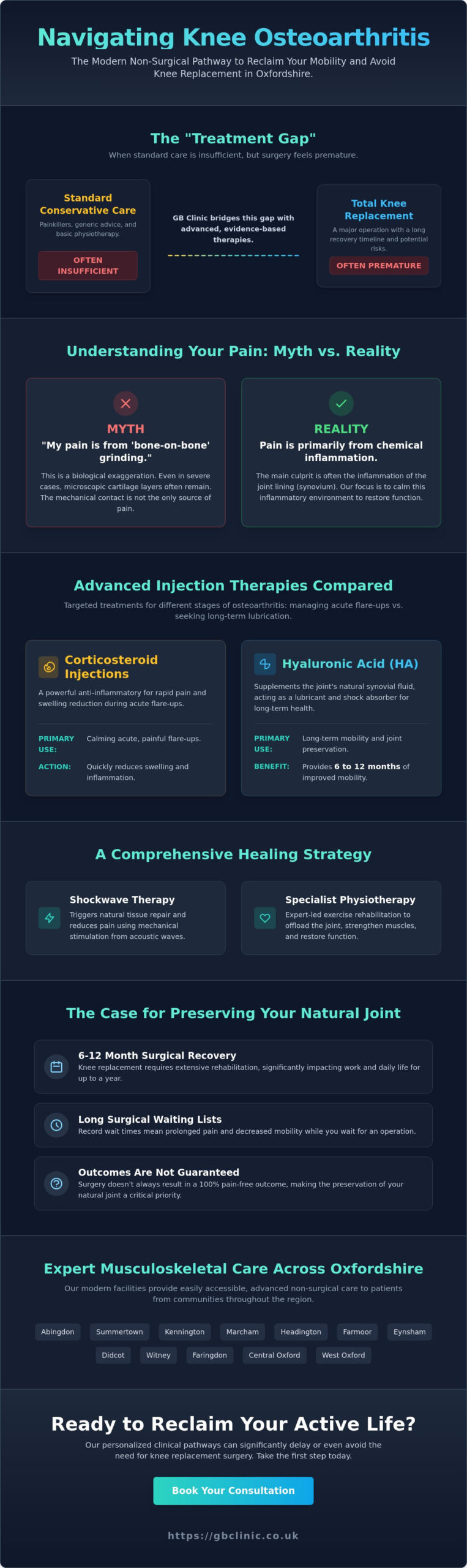
A common challenge for patients in Headington and Abingdon is the “Treatment Gap.” This clinical stage occurs when standard conservative care, such as basic painkillers, no longer provides relief, yet the joint damage isn’t severe enough to warrant major surgery. Non-surgical treatment for knee osteoarthritis is a multi-modal approach designed specifically to bridge this gap by preserving joint function and managing inflammation. This strategy focuses on maintaining the natural joint for as long as possible, providing a professional alternative for those who aren’t ready for the operating theatre.
To better understand this concept, watch this helpful video:
The Biological Reality of the “Bone-on-Bone” Myth
The phrase “bone-on-bone” is frequently used to describe advanced arthritis, but it’s often a biological exaggeration. Even in severe cases, microscopic cartilage layers usually remain present. The primary source of pain is often the chemical inflammation of the joint lining rather than just physical contact. At GB Clinic, our focus is on quietening this inflammatory environment to restore pain-free movement. By addressing the joint’s internal chemistry, we help patients from Witney, Didcot, Marcham, and Farmoor regain their mobility. This shift in perspective allows us to use specialist physiotherapy to offload the joint effectively.
Why Avoiding Surgery is a Priority for Modern Patients
Total knee replacement is a major procedure with a recovery timeline that can extend from six to twelve months. In 2024, surgical waiting lists across the UK reached record lengths, leaving many patients in Summertown, Kennington, Eynsham, and Faringdon searching for immediate solutions. Beyond the wait, surgery doesn’t always guarantee a 100% pain-free outcome, making the preservation of the natural joint a critical priority. Modern non-surgical options allow you to manage your condition without the risks of a hospital stay. By focusing on evidence-based therapies, we help you stay active and independent while avoiding the significant downtime associated with invasive operations.
Advanced Injection Therapies: Hyaluronic Acid vs. Steroids
Choosing the right non-surgical treatment for knee osteoarthritis depends on whether you’re managing an acute flare-up or seeking long-term lubrication. While many patients in Abingdon and Summertown are familiar with traditional options, the choice between corticosteroids and Hyaluronic Acid is fundamental to joint health. Corticosteroids act as powerful anti-inflammatories to reduce swelling quickly. In contrast, Hyaluronic Acid (HA) injections work by supplementing the natural synovial fluid that has thinned due to wear. Understanding your Osteoarthritis symptoms and causes is the first step in determining which biological approach fits your current stage of joint degeneration.
Hyaluronic Acid provides a mechanical benefit by acting as a shock absorber. For residents in Kennington and Marcham, this often translates to 6 to 12 months of significantly improved mobility. For those in the early-to-mid stages of the condition, PRP (Platelet Rich Plasma) offers a regenerative alternative by using the patient’s own blood to stimulate tissue repair. These biological therapies focus on maintaining the natural joint environment rather than just masking pain. It’s a proactive way to manage musculoskeletal health without jumping straight to the operating theatre.
The Role of Ultrasound-Guided Precision
Landmark-based or “blind” injections have higher failure rates and can cause unnecessary discomfort. At our clinics serving Headington, Farmoor, and Eynsham, we use diagnostic ultrasound scans for every procedure. This technology ensures the needle reaches the precise intra-articular space every time. Guided precision increases the safety and efficacy of the treatment, giving patients in Central Oxford and West Oxford confidence in their clinical outcomes. If you’re unsure about your current joint health, you can book a consultation to discuss these advanced imaging options and see how they improve accuracy.
Corticosteroids: When are they the right choice?
There’s a specific place for guided steroid injections, particularly during acute flare-ups. If you’re in Didcot or Witney and experiencing severe swelling that prevents basic movement, a steroid can provide the immediate relief needed to start rehabilitation. However, clinical evidence suggests limiting the frequency of these injections to protect long-term cartilage health. For patients in Faringdon, we often recommend steroids for rapid relief followed by HA for sustained lubrication. This combined strategy ensures you get back on your feet quickly while supporting the joint’s mechanical needs over the coming months.
Mechanical Healing: Shockwave Therapy and Specialist Physiotherapy
Injections provide a biological foundation for recovery, but mechanical healing is equally vital for a successful non-surgical treatment for knee osteoarthritis. For residents in Abingdon and Summertown, addressing the structural stressors around the joint is the next logical step. Extracorporeal Shockwave Therapy (ESWT) uses high-energy sound waves to stimulate blood flow and accelerate tissue repair in the tendons and ligaments surrounding the knee. You can find a deeper technical breakdown of this technology in our Shockwave Therapy guide. This modern modality is essential for patients in Central Oxford and West Oxford who find that standard exercise alone isn’t enough to overcome chronic stiffness.
Our clinical approach prioritises a whole-limb perspective to ensure long-term relief. When a knee joint is compromised, the body naturally compensates, often leading to secondary pain in the hips and ankles. Patients in Headington and Farmoor benefit from advanced physiotherapy that targets these compensatory patterns. We use a structured model to resolve these issues: the Problem of joint restriction is met with the Solution of manual therapy and myofascial release, resulting in the Benefit of restored range of motion and reduced strain. This comprehensive Knee Osteoarthritis treatment strategy ensures that every patient receives care tailored to their specific biomechanical needs.
How Shockwave Therapy Benefits the Osteoarthritic Knee
The effectiveness of ESWT lies in a process called mechanotransduction. This occurs when sound waves trigger a biological healing response at a cellular level, helping to restart the repair process in tissues that have become stagnant. For individuals in Kennington and Marcham, this treatment is particularly effective at reducing levels of substance P, a key neurotransmitter associated with chronic pain. By lowering the chemical signals of discomfort, we can help you transition into more active rehabilitation. It’s an excellent option if you also suffer from associated patellar tendinopathy or bursitis, which frequently complicate the clinical picture of osteoarthritis.
Exercise Rehabilitation: Moving Beyond Generic Advice
Generic advice to “walk more” is often counterproductive for an osteoarthritic knee. Patients in Eynsham, Didcot, and Witney require specific load-management protocols that protect the joint while building capacity. We focus heavily on gluteal and quadriceps strengthening, as these muscles act as the primary shock absorbers for the lower limb. By increasing the strength of these muscle groups, we can significantly offload the stress placed on the knee joint itself. In Faringdon, our specialists often use gait analysis to identify the subtle biomechanical stressors that contribute to joint wear. This data-driven approach ensures your rehabilitation program is both safe and effective for your unique anatomy.
Navigating Your Treatment Journey in Oxfordshire
Residents in Central Oxford and West Oxford often struggle with the slow pace of standard medical referrals. Finding an effective non-surgical treatment for knee osteoarthritis requires a more direct approach. We’ve established a clinical pathway at GB Clinic that prioritises speed and accuracy for patients in Abingdon, Witney, and Didcot. By offering a “one-stop” setup, we ensure that your diagnostic assessment and initial treatment plan are completed in a single visit. This convenience is a primary reason why patients from Summertown, Headington, and Kennington choose our specialist services. You don’t have to spend weeks waiting for a separate scan before your first treatment can begin.
Choosing a Local MSK Specialist
When you’re choosing a musculoskeletal specialist in Oxford, it’s vital to look for a clinic that combines advanced technology with a patient-focused approach. Our facilities are easily accessible for those travelling from Farmoor, Faringdon, Eynsham, and Marcham. We focus on providing a clear diagnosis through on-site ultrasound, which allows us to bypass the common “referral merry-go-round” found in larger hospital systems. This means you get answers faster and can start your recovery sooner. Our high volume of positive patient testimonials highlights our commitment to being professional and reassuring throughout your care. You can view our clinical services to learn more about our specialist-led approach.
What to Expect During Your Initial Consultation
Your journey begins with a comprehensive consultation designed to provide a definitive diagnosis. We follow a logical, evidence-based process to ensure no detail is overlooked:
- Clinical History: We start with a detailed discussion of your symptoms and how they affect your daily activities, such as walking in the countryside or your professional life.
- Physical Assessment: A physical examination helps us understand your knee joint’s range of motion, stability, and any areas of specific tenderness.
- On-site Ultrasound: We use high-resolution diagnostic ultrasound scans to confirm the degree of OA and assess the joint’s condition in real-time.
- Bespoke Plan: Based on these findings, we create a tailored strategy that might include Hyaluronic Acid injections, Shockwave Therapy, or specialist rehabilitation.
This structured process ensures that every non-surgical treatment for knee osteoarthritis we provide is backed by clear evidence. Our goal is to provide you with the best possible chance of avoiding invasive surgery while restoring your knee mobility.
The GB Clinic Approach: Personalised Care for Knee Pain
GB Clinic serves as the trusted partner for musculoskeletal health across Oxfordshire. We understand that living with chronic knee pain isn’t just a physical challenge; it’s a barrier to the life you want to lead. Our clinical model follows a clear Problem, Solution, and Benefit structure. The Problem of persistent joint inflammation and stiffness is met with our Solution of modern, targeted therapies like Hyaluronic Acid injections and Shockwave Therapy. This leads to the ultimate Benefit: a return to a pain-free life without the need for invasive surgical intervention. Patients from Abingdon and Summertown consistently describe our care as “very kind and considerate,” a sentiment reflected in our numerous local testimonials.
Our goal is to ensure every resident in Kennington, Marcham, and Headington has access to a viable non-surgical treatment for knee osteoarthritis. We don’t believe in generic advice that only addresses symptoms. Instead, we use diagnostic ultrasound scans to pinpoint the exact state of your joint. This allows us to provide a professional, evidence-based alternative to the long waiting lists associated with the millions of people in England currently diagnosed with knee osteoarthritis. Whether you’re in Farmoor or Eynsham, our specialists are committed to providing a clear, efficient path to recovery.
Why Our Oxford Patient Community Trusts Us
Our clinical expertise in ultrasound-guided procedures and advanced Extracorporeal Shockwave Therapy (ESWT) sets us apart as a modern specialist provider. We’ve designed our services to be highly accessible for individuals in Didcot, Witney, and Faringdon. The clinic’s location in Central Oxford and West Oxford acts as a central hub for the entire county, reducing travel times for those in pain. To make the first step as easy as possible, we offer a personal consultation with zero commitment. This risk-free entry point allows you to discuss your condition with a professional and understand your options before making any decisions. It’s an approach that prioritises patient confidence and clinical excellence above all else.
Taking the Next Step Toward Recovery
It’s time to stop “just managing” your knee pain with temporary fixes. Long-term recovery is possible when you treat the root cause of the discomfort rather than just the surface-level symptoms. For many of our patients, this means delaying or entirely avoiding the need for a hospital stay or a total knee replacement. If you’re ready to explore a comprehensive non-surgical treatment for knee osteoarthritis, the next step is simple. You can book an assessment at our Oxford clinic today. Our team is ready to help you restore your mobility and get you back to enjoying the Oxfordshire countryside without restriction.
Restore Your Mobility with Advanced MSK Care
Managing joint pain shouldn’t mean waiting for surgery or relying on generic advice that feels insufficient. We’ve explored how a comprehensive non-surgical treatment for knee osteoarthritis combines biological lubrication with mechanical healing to preserve your natural joint. For residents in Abingdon, Summertown, and Kennington, these modern therapies are available right on your doorstep. Whether you’re in Marcham, Headington, or Farmoor, the path to recovery is closer than you think.
Our Oxford-based MSK specialists use on-site diagnostic ultrasound to ensure every treatment is precise and effective. We provide advanced Hyaluronic Acid and Shockwave Therapy to patients across Eynsham, Didcot, and Witney. If you’re based in Faringdon, Central Oxford, or West Oxford, our one-stop setup is designed to save you time and reduce discomfort. You can Book Your Specialist Knee Assessment at GB Clinic Oxford to begin your personalized rehabilitation journey. It’s entirely possible to return to the activities you love without a hospital stay. We’re here to provide the professional, expert-led care you need to move forward with confidence.
Frequently Asked Questions
Is non-surgical treatment effective for “bone-on-bone” knee osteoarthritis?
Non-surgical treatment for knee osteoarthritis is often highly effective even when patients have been told their condition is “bone-on-bone.” Clinical evidence shows that inflammation, rather than just structural wear, drives the majority of pain. By quietening the joint environment, patients in Abingdon and Headington can restore significant mobility. We use ultrasound-guided injections to target specific inflammatory pockets that are often missed in standard assessments, helping you avoid invasive operations.
How long do the effects of a Hyaluronic Acid injection usually last?
The therapeutic effects of a Hyaluronic Acid injection typically last between 6 and 12 months. This duration depends on your activity levels and the severity of the joint degeneration. Residents in Summertown and Kennington often find that a single dose provides enough lubrication to return to low-impact exercise. Regular follow-up assessments help us determine the optimal timing for repeat treatments to maintain long-term joint health and comfort.
Does Shockwave Therapy hurt when used for knee pain?
Shockwave Therapy is generally described as a series of intense pulses rather than sharp pain. While it can be slightly uncomfortable, our specialists in West Oxford and Central Oxford can adjust the intensity to match your tolerance level. Each session lasts approximately 10 to 15 minutes, and any mild soreness usually resolves within 24 hours. Most patients find the temporary discomfort well worth the subsequent reduction in chronic stiffness.
Will I need a GP referral to see a private MSK specialist in Oxford?
You don’t need a GP referral to access our specialist musculoskeletal services in Oxfordshire. We accept self-referrals from patients in Marcham, Farmoor, and Eynsham who are seeking faster diagnostic answers. This direct access allows you to bypass the standard waiting lists and start your treatment journey immediately. Our one-stop setup ensures that your initial assessment and diagnostic ultrasound happen during your first visit, saving you time.
Can I drive home immediately after a guided knee injection?
Most patients can drive home immediately after receiving a guided knee injection at our clinic. We recommend waiting in our reception area for 15 to 20 minutes to ensure you feel completely comfortable before starting your journey back to Didcot or Witney. While the injection site might feel slightly heavy, it doesn’t typically interfere with your ability to operate a vehicle. We provide clear aftercare instructions to ensure your recovery is smooth.
What is the success rate for avoiding surgery through these non-surgical methods?
Clinical data suggests that up to 80% of patients with early-to-mid stage osteoarthritis can successfully delay or avoid surgery through targeted non-surgical treatment for knee osteoarthritis. By combining biological injections with mechanical therapies, we address both the chemical and structural causes of pain. For residents in Faringdon and Headington, this approach offers a significant alternative to the risks and long recovery times associated with total knee replacement surgery.
Are these treatments covered by private health insurance in the UK?
Many private health insurance providers in the UK cover our diagnostic scans and specialist injections. However, coverage for specific therapies like Shockwave or Hyaluronic Acid varies depending on your individual policy. We advise patients in Abingdon and Summertown to contact their insurer before their appointment to confirm their level of cover. Our team can provide the necessary clinical codes and documentation to help streamline your claim process and avoid delays.
How many sessions of Shockwave Therapy are typically required for knee OA?
A typical course of Shockwave Therapy involves 3 to 6 sessions, spaced approximately one week apart. This frequency allows the body’s natural healing response to activate between treatments. Patients in Kennington and Marcham often report a noticeable improvement in mobility after the second or third session. We combine these sessions with a tailored exercise program to ensure the mechanical benefits are supported by improved muscle strength and joint stability.