What if your chronic pain isn’t a permanent condition, but simply a biological stalemate where your body has stopped trying to heal? It’s exhausting to live with persistent musculoskeletal issues that don’t respond to traditional rest or medication. You might feel frustrated by treatments that haven’t worked or anxious about the prospect of invasive surgery. Our clinical team recognizes that for many patients, the primary goal is a return to sports and daily activities without the risks of the operating theatre. This guide explains how advanced extracorporeal shockwave therapy for chronic pain management can mechanically restart your body’s natural healing process.
By delivering high-energy acoustic waves to injured tissue, this non-surgical intervention provides long-term relief and a clear timeline for recovery. We believe that clinical excellence should be accessible, which is why we’ve positioned our services to support residents across the region. Whether you’re seeking expert care from Abingdon, Summertown, Kennington, or Marcham, our specialist approach ensures you receive evidence-based treatment close to home. We provide straightforward solutions for those in Headington, Farmoor, Eynsham, and Didcot. Patients in Witney, Faringdon, Central Oxford, and West Oxford can finally access a modern path to physical restoration that prioritizes both comfort and long-term mobility.
Key Takeaways
- Learn how acoustic pressure waves restart the body’s natural healing process by stimulating neovascularisation and breaking the cycle of chronic inflammation.
- Discover why shockwave therapy for chronic pain management is a proven, non-surgical solution for resolving debilitating conditions like plantar fasciitis and Achilles tendonopathy.
- Understand the role of high-resolution diagnostic ultrasound in providing an accurate visualization of your injury to ensure targeted and effective treatment.
- Explore the patient journey from the initial clinical assessment to the completion of a typical 15-minute therapy session.
- See how specialized care is easily accessible for patients throughout Oxfordshire, including those in Summertown, Didcot, and Central Oxford.
Understanding Shockwave Therapy for Chronic Pain Management
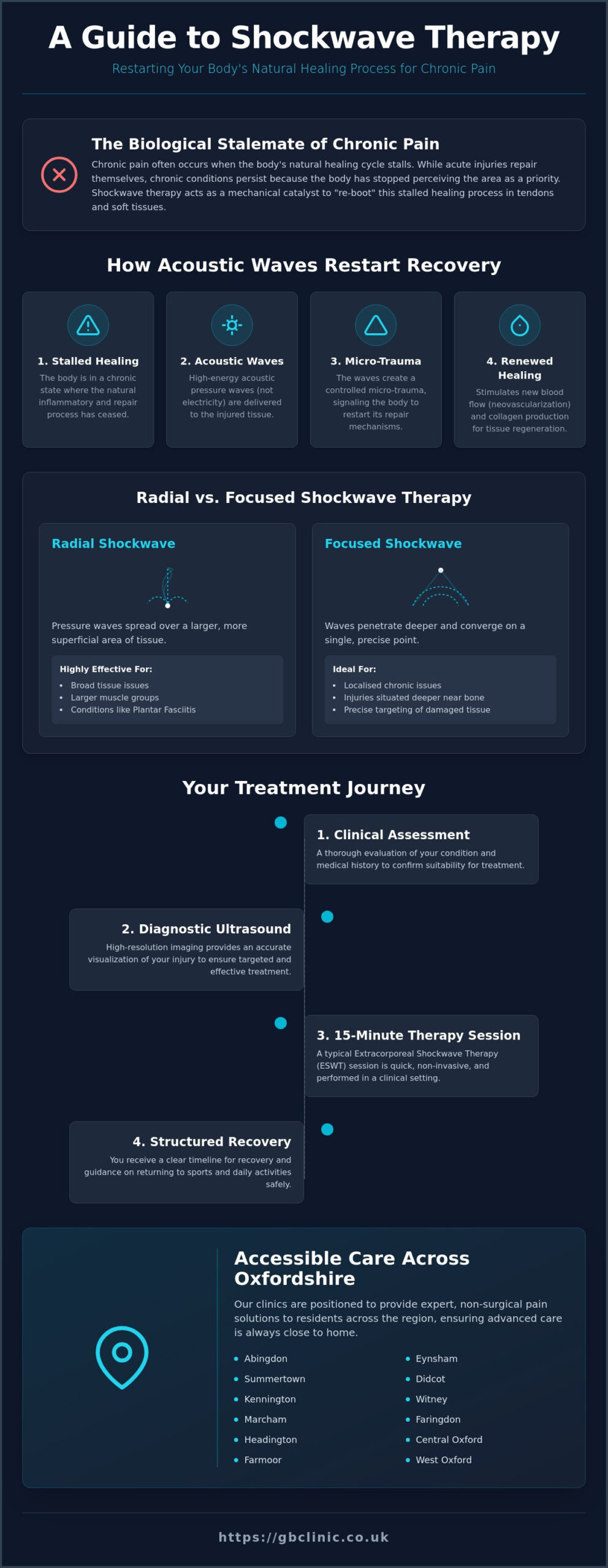
Chronic pain often represents a biological stalemate. While acute injuries typically follow a predictable healing path of inflammation, repair, and remodelling, chronic conditions occur when this cycle stalls. When traditional rest, ice, and basic stretching no longer provide relief, it’s usually because the body has stopped perceiving the injury as a priority for repair. This is where shockwave therapy for chronic pain management becomes a vital intervention. It acts as a mechanical catalyst, effectively “re-booting” the stalled healing process in tendons and soft tissues that have become degenerative rather than just inflamed.
Many patients feel apprehensive when they hear the word “shock,” often associating it with electrical currents. However, Extracorporeal Shockwave Therapy (ESWT) uses acoustic pressure waves, not electricity. These high-energy sound waves travel through the skin to reach the targeted musculoskeletal tissues. In the UK, ESWT is increasingly recognized as the gold standard for chronic tendon pathologies because it offers a non-invasive alternative to surgery with a high success rate for those who have exhausted other conservative options.
What is Extracorporeal Shockwave Therapy (ESWT)?
This technology has a fascinating clinical history, originally developed in the 1980s as lithotripsy to break up kidney stones without surgery. Clinicians soon noticed that patients undergoing this treatment experienced improved bone density and soft tissue healing in the surrounding areas. To understand the broader medical context, you can read more about What is Extracorporeal Shockwave Therapy (ESWT) and its evolution into modern sports medicine. Extracorporeal Shockwave Therapy is a mechanical intervention that uses acoustic energy to create micro-trauma in targeted tissues, which in turn triggers a fresh biological repair response. This process stimulates blood flow and the production of collagen, which is essential for repairing damaged tendons.
Radial vs. Focused Shockwave: Which is Right for You?
Not all shockwave treatments are identical. Depending on the depth and nature of your pain, a specialist will select between two primary modalities:
- Radial Shockwave: These waves spread over a larger, more superficial area. This is highly effective for treating broad tissue issues like plantar fasciitis or larger muscle groups.
- Focused Shockwave: These waves penetrate deeper into the body and converge on a single, precise point. This is ideal for localized chronic issues or injuries situated deeper near the bone.
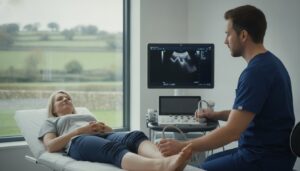
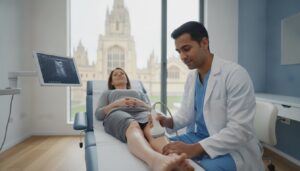
A musculoskeletal specialist in Oxford will determine the most appropriate modality based on your specific diagnosis. At our clinics, we often utilize a diagnostic ultrasound scan to visualize the exact state of the tissue before beginning treatment. This ensures the acoustic energy is delivered with clinical precision.
Our clinics are strategically located to remain accessible for residents across Oxfordshire. We provide a convenient local choice for patients travelling from Abingdon, Summertown, and Kennington. Whether you’re commuting from Marcham, Headington, or Farmoor, our goal is to provide expert-led care without the need for long-distance travel. We also regularly welcome patients from Eynsham, Didcot, Witney, and Faringdon, as well as those living and working in Central Oxford and West Oxford, ensuring that advanced shockwave therapy for chronic pain management is never out of reach.
The Science of Healing: How Shockwave Therapy Restarts Recovery
When pain persists for months, the body often enters a state of metabolic hibernation. In this chronic phase, the natural inflammatory response has faded, yet the tissue remains damaged and weak. This is precisely why shockwave therapy for chronic pain management is so effective. It doesn’t just mask symptoms; it uses high-energy acoustic pulses to create controlled “micro-trauma” at the site of injury. This mechanical stimulus signals the body to restart its inflammatory process, effectively waking up dormant cellular repair mechanisms that have long since given up on the healing task.
A critical component of this recovery is neovascularisation. Many chronic tendon injuries suffer from poor blood supply, which prevents essential nutrients from reaching the damaged area. The acoustic waves from the shockwave device stimulate the growth of new, microscopic blood vessels. This improved circulation delivers the oxygen and proteins necessary for structural repair. Simultaneously, the treatment reduces the concentration of Substance P, a neurotransmitter responsible for transmitting pain signals. This lead to both immediate relief and a long-term reduction in localized sensitivity.
From Chronic Stalemate to Active Repair
It’s important to distinguish between “tendonitis” (acute inflammation) and “tendonosis” (chronic degeneration). In chronic cases, the tendon’s collagen fibres become disorganized and brittle. Shockwave therapy upregulates collagen production, which is the foundational building block of healthy connective tissue. By stimulating metabolic activity in these poorly vascularised zones, the therapy helps reorganize these fibres into a strong, functional structure. If you’re ready to move beyond temporary relief, you can learn more about our comprehensive clinical approach to long-term recovery.
Evidence-Based Outcomes for Persistent Pain
Clinical data supports the use of this technology for those who haven’t found success with traditional physiotherapy or rest. Research indicates a success rate between 60% and 80% for chronic conditions that have failed to respond to other conservative treatments. Because of this strong evidence base, the National Institute for Health and Care Excellence (NICE) has issued guidance supporting the use of shockwave therapy for specific persistent issues like plantar fasciitis and Achilles tendinopathy. Unlike corticosteroid injections, which focus on reducing inflammation and can sometimes weaken tissue over time, shockwave therapy for chronic pain management focuses on the structural restoration of the injury site.
We’ve designed our service to be the local choice for patients throughout the region. Residents in Abingdon, Summertown, and Kennington can access these advanced treatments without a long commute. Our reach extends to the communities of Marcham, Headington, and Farmoor, ensuring expert-led care is always nearby. We also provide dedicated support for individuals in Eynsham, Didcot, Witney, and Faringdon. For those living or working in Central Oxford and West Oxford, our clinics offer a professional, clinical environment focused entirely on your return to a mobile, pain-free lifestyle.
Common Chronic Conditions Treated with ESWT
While the biological mechanisms are complex, the clinical application of shockwave therapy for chronic pain management is straightforward and highly effective for several specific conditions. Most patients we treat have already spent months trying rest, ice, or basic stretching without achieving lasting relief. We focus on conditions where the tissue has failed to heal correctly, leading to persistent discomfort that limits daily mobility and quality of life.
Common conditions treated with ESWT include:
- Plantar Fasciitis: Resolving chronic heel pain that makes the first steps of the day agonizing and limits walking distance.
- Achilles Tendonopathy: Repairing the thickest tendon in the body by addressing degenerative changes without surgical intervention.
- Tennis and Golfer’s Elbow: Addressing persistent epicondylitis when rest, braces, and straps have failed to provide a solution.
- Calcific Tendonitis of the Shoulder: Using acoustic energy to mechanically break down painful calcium deposits within the rotator cuff.
- Patellar Tendonitis (Jumper’s Knee): Restoring function and structural integrity for athletes and active individuals.
Lower Limb Applications: Feet, Ankles, and Knees
Lower limb injuries frequently become chronic because these structures bear our full body weight during every daily activity. Plantar fasciitis is a prime example where the thick band of tissue under the foot becomes degenerate rather than just inflamed. Most patients notice a significant reduction in symptoms after 3 to 5 sessions, with full tissue remodelling occurring over the following weeks. For athletes dealing with Jumper’s Knee, shockwave therapy provides a reliable, non-surgical route to restore the patellar tendon’s integrity. This treatment is a core part of our recovery protocols for patients visiting us from Abingdon, Summertown, and Kennington.
Upper Limb and Hip Solutions
Upper limb conditions like Tennis Elbow or Calcific Tendonitis of the shoulder respond exceptionally well to acoustic pressure waves. In calcific cases, the waves help break down painful calcium deposits that have formed within the rotator cuff tendons, often providing relief where other treatments failed. We also use this technology to treat Greater Trochanteric Pain Syndrome (GTPS), a common cause of chronic hip pain that often mimics bursitis, where shockwave therapy for trochanteric bursitis has demonstrated up to 80% improvement rates in clinical data. Effective recovery often requires a combination of shockwave to restart healing and expert-led physiotherapy to rebuild strength and prevent the injury from recurring.
Our clinics are strategically located to be the convenient choice for residents in Marcham, Headington, and Farmoor. We provide specialized care for those in Eynsham and Didcot who are seeking an evidence-based alternative to persistent pain. If you’re based in Witney, Faringdon, Central Oxford, or West Oxford, our team offers a professional path toward physical restoration, ensuring you can return to the sports, hobbies, and activities you enjoy without the need for invasive procedures.
What to Expect: Your Treatment Journey in Oxfordshire
Every successful recovery begins with an accurate clinical picture. Before starting shockwave therapy for chronic pain management, our senior clinicians conduct a thorough initial assessment to ensure that your condition is suitable for acoustic wave treatment. This stage is vital because treating an acute tear with shockwave could be counterproductive. We often utilize an in-house diagnostic ultrasound scan to visualize the tendon structure and confirm the presence of degenerative changes or calcifications. Once a clear diagnosis is established, we create a structured plan tailored to your specific recovery goals.
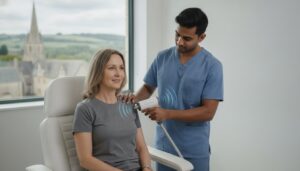
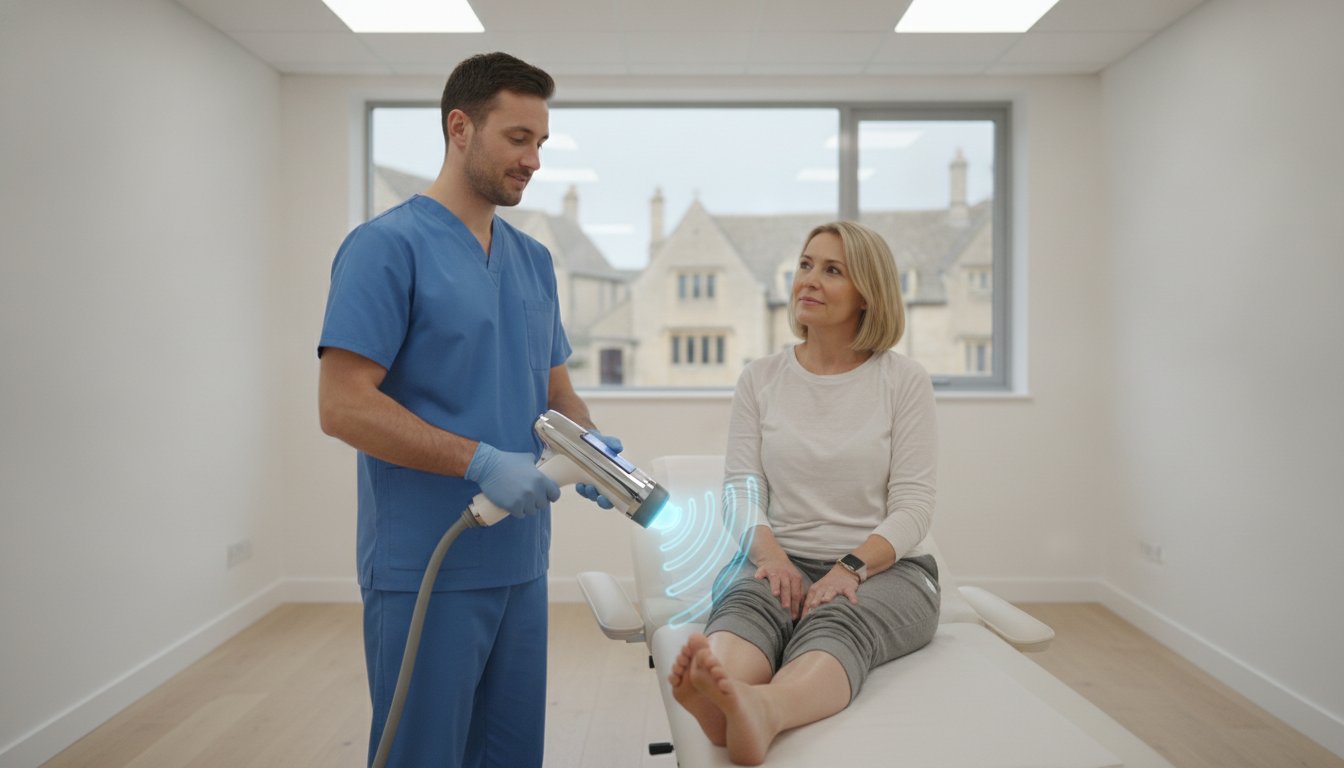
A typical treatment session is efficient and focused, usually lasting between 15 and 20 minutes. Your clinician will apply a conductive gel to the skin over the injured area to ensure the acoustic waves travel effectively into the tissue. The shockwave probe is then moved in a circular or grid-like pattern over the site of pain. Most patients require a course of 3 to 6 sessions, spaced approximately one week apart, to allow the body’s regenerative processes to take hold between appointments.
The Sensation: Does Shockwave Therapy Hurt?
Patients often describe the sensation as a fast, rhythmic tapping or a deep pulsing. While it can be uncomfortable, it shouldn’t be unbearable. We maintain a constant dialogue during the session and can adjust the intensity of the device to match your comfort level. This temporary discomfort is actually a positive clinical sign, as it indicates the pulses are accurately targeting the damaged tissue. You might experience some mild soreness or redness in the treated area for 24 to 48 hours after the session. This is a normal part of the “healing response” as the body begins the structural repair work discussed in earlier sections.
Local Care for Oxfordshire Residents
We’ve focused on making advanced musculoskeletal care highly accessible for people living throughout the county. If you’re based in Summertown, Headington, or Central Oxford, our clinics provide a professional environment for recovery right on your doorstep. We understand that traveling for treatment can be difficult when you’re in pain, so we’ve ensured our locations are easy to reach for those in West Oxford, Kennington, and Farmoor.
Our service acts as a convenient local hub for residents in surrounding towns. Patients regularly visit us from Abingdon, Witney, and Didcot for specialist interventions. We also serve the wider communities of Marcham, Eynsham, and Faringdon, providing a clear path to recovery without the need for hospital waiting lists or invasive surgery. If you’re ready to begin your recovery, you can book your initial clinical assessment with our expert team today.
After your session, we provide specific guidance on activity levels. While you don’t need to bed rest, we usually recommend avoiding high-impact exercise for 48 hours to let the stimulated tissue settle. This measured approach ensures the mechanical energy delivered during your session translates into the best possible long-term functional outcome.
Why Choose GB Clinic for Advanced MSK Care in Oxford?
Effective shockwave therapy for chronic pain management requires more than just high-end equipment. It demands the clinical insight of senior specialists who can interpret complex musculoskeletal pathologies. Our clinic prioritizes an expert-led approach where every treatment is performed by clinicians with extensive experience in sports medicine and rehabilitation. We don’t believe in generic “wait and see” strategies that leave patients in discomfort for months. Instead, we offer a clear, proactive path to recovery designed to restore your mobility without unnecessary delays.
We’ve built our reputation on providing comprehensive care that goes beyond a single modality. In many cases, we integrate ESWT with other advanced interventions like Hyaluronic Acid Injections or Guided Steroid Injections to address multi-faceted pain. This ensures that whether you’re dealing with joint degeneration or soft tissue damage, your treatment plan is robust and evidence-based. Our clinics are a local choice for residents in Abingdon, Summertown, and Kennington, offering the same level of specialist care found in major teaching hospitals.
The Advantage of Ultrasound-Guided Precision
Accuracy is the foundation of our success rates. By using Diagnostic Ultrasound to visualize the injury site, we can pinpoint the exact location of a tear or calcification before the first acoustic wave is delivered. This precision ensures the energy is focused exactly where it’s needed most, significantly improving outcomes for persistent conditions. For those with highly complex or multi-site injuries, our Best Musculoskeletal Specialist Oxford provides the diagnostic depth required for a successful recovery journey.
Tailored Rehabilitation Programmes
While shockwave therapy is a powerful catalyst for healing, long-term success often depends on what happens after the session. We provide personalized exercise rehabilitation plans that help strengthen the newly repaired tissue and prevent the injury from returning. This holistic view of recovery is why patients travel to us from Marcham, Headington, and Farmoor. Our reach extends to the communities of Eynsham, Didcot, and Witney, ensuring that expert care is always accessible.
Whether you’re based in Faringdon, Central Oxford, or West Oxford, our team is committed to your functional restoration. We invite you to book a consultation at our Physiotherapy Oxford clinic to discover how a combination of advanced technology and clinical expertise can end your cycle of chronic pain. We provide a professional, calm environment where your recovery is the sole priority.
Start Your Journey Toward Lasting Pain Relief
Living with persistent musculoskeletal discomfort doesn’t have to be your permanent reality. By choosing shockwave therapy for chronic pain management, you’re opting for a NICE-recommended protocol that focuses on structural repair rather than temporary symptom masking. Our integration of diagnostic ultrasound ensures that every treatment is delivered with clinical accuracy, targeting the exact site of your injury to maximize success rates.
Our expert MSK clinicians are dedicated to serving the entire Oxfordshire community. We’ve made it simple for residents in Abingdon, Summertown, and Kennington to access advanced care close to home. Whether you’re traveling from Marcham, Headington, or Farmoor, our clinics provide a clear, evidence-based path to recovery. We also welcome patients from Eynsham, Didcot, Witney, and Faringdon, as well as those living in Central Oxford and West Oxford.
Don’t let chronic discomfort limit your hobbies or daily life any longer. You can Book Your Initial Shockwave Therapy Consultation in Oxford today and begin the process of physical restoration. We’re here to help you return to the mobile, active lifestyle you deserve.
Frequently Asked Questions
Is shockwave therapy a permanent fix for chronic pain?
Shockwave therapy provides long-term structural repair by stimulating the body’s natural healing response. It is not a temporary mask like some medications. Because it addresses the underlying tissue degeneration, the results are typically durable and lasting. Residents in Abingdon and Marcham often find this provides the permanent relief they need to return to active lifestyles without recurring symptoms or the need for surgery.
How many sessions of shockwave therapy will I need?
Most patients require between three and six sessions to achieve optimal results. These appointments are usually scheduled one week apart to allow the biological repair process to progress effectively between visits. While some individuals in Summertown or Kennington notice immediate improvement after the first session, the full benefits of shockwave therapy for chronic pain management often manifest several weeks after the final session as collagen production peaks.
Can I drive home after a shockwave therapy session?
You can safely drive home immediately following your appointment. The treatment is entirely non-invasive and does not involve any sedation or local anaesthetic that would impair your ability to operate a vehicle. Whether you are traveling back to Witney, Didcot, or Faringdon, you won’t need to arrange for a driver or take significant time off work. Most people return to their normal daily routine right away.
Are there any side effects to shockwave therapy for chronic pain?
Side effects are generally mild and temporary. You might experience some localized redness, minor bruising, or a dull ache in the treated area for 24 to 48 hours. This is actually a positive sign that the treatment is successfully triggering the inflammatory response required for tissue repair. Patients across Headington and West Oxford find these minor effects are a small trade-off for the significant long-term pain reduction they experience.
Is shockwave therapy covered by private health insurance in the UK?
Many major private health insurance providers in the UK cover this treatment for specific musculoskeletal conditions. We recommend checking your specific policy details or contacting your insurer directly to confirm your level of cover before starting. Our clinics support patients from Farmoor and Eynsham who utilize their private health benefits to access advanced shockwave therapy for chronic pain management without the delays often found in other healthcare settings.
What happens if shockwave therapy doesn’t work for my condition?
If shockwave therapy doesn’t provide the expected relief, we re-evaluate your condition using our precision diagnostic tools. While the success rate for chronic conditions is between 60% and 80%, we offer several alternative interventions like Hyaluronic Acid injections or specialized exercise rehabilitation. Our goal is to find a solution that works for your specific pathology, ensuring patients in Central Oxford always have a clear path forward toward recovery.
Can shockwave therapy be used alongside steroid injections?
Shockwave therapy should not be used in the same anatomical area as a recent steroid injection. You must wait at least 12 weeks after a corticosteroid shot before starting your first session. This wait period ensures the steroid has fully settled, as its anti-inflammatory properties can interfere with the pro-inflammatory healing response that shockwave therapy aims to stimulate in the damaged tissue.
Who should avoid shockwave therapy (contraindications)?
Certain conditions make this treatment unsuitable for safety reasons. You should avoid shockwave therapy if you are pregnant, have a cardiac pacemaker, or are taking anticoagulant medication like warfarin. It is also contraindicated if there is an active infection or a known tumour in the treatment area. Our clinical team conducts a thorough screening for every patient to ensure total safety before we begin any therapeutic intervention.