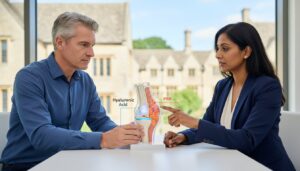

A generic pair of high street running shoes cannot fix a complex biomechanical misalignment that has developed over several years. If you’ve been struggling with persistent joint pain despite resting or buying recommended footwear, you aren’t alone. Many patients feel frustrated by technical jargon when understanding your gait analysis results, often leaving them confused about terms like overpronation or calcaneal eversion. With NHS waiting times for Trauma and Orthopaedics in Oxfordshire currently averaging 17 weeks as of February 2026, finding a faster, data-driven solution is essential for your long-term recovery.
This guide simplifies your clinical report so you can finally identify the root cause of your pain. We’ll explain how to interpret your biomechanical data and how these insights justify advanced treatments like Shockwave Therapy or Hyaluronic Acid injections. Whether you’re based in Abingdon, Summertown, Kennington, or Marcham, our expert-led clinics provide a professional treatment plan tailored to your specific needs. We ensure residents in Headington, Farmoor, Eynsham, and Didcot have local access to modern MSK care. From Witney and Faringdon to Central and West Oxford, we’re here to help you restore mobility and return to a pain-free lifestyle.
Key Takeaways
- Access clinical motion studies in Abingdon, Summertown, or Kennington to identify the specific biomechanical triggers causing your persistent joint discomfort.
- Gain clarity on complex terminology like pronation and supination, which is vital for understanding your gait analysis results and creating a personalized recovery plan in Marcham or Headington.
- Differentiate between basic retail footwear checks and the advanced clinical assessments available to patients in Farmoor, Eynsham, and Didcot.
- See how your gait data justifies modern musculoskeletal treatments such as Hyaluronic Acid injections or Shockwave Therapy for residents in Witney and Faringdon.
- Learn the simple steps to book a professional assessment in Central or West Oxford, beginning with a risk-free personal physiotherapy consultation.
Decoding Your Gait Analysis: Why It Matters for Oxfordshire Patients
Gait analysis is the systematic study of human motion, using professional observation and advanced instrumentation, such as sensor-based technology, to measure body movements and muscle activity. For patients residing in Abingdon or Summertown, this assessment serves as the vital first step in a comprehensive clinical musculoskeletal (MSK) evaluation. Unlike a casual observation, a clinical study provides precise data on your efficiency, balance, and limb coordination. Understanding your gait analysis results allows our specialists to pinpoint the exact biomechanical triggers that lead to recurring pain, rather than simply treating the symptoms.
To better understand what happens during a professional assessment, watch this helpful video:
The Clinical Purpose of Gait Assessment
A clinical assessment in Oxfordshire is a medical necessity for those suffering from chronic pain. While sports shops often focus on footwear, our diagnostic approach looks deeper into your joint health. At GB Clinic, we follow a clear Problem/Solution/Benefit framework. We identify a specific mechanical issue, provide a targeted physiotherapy plan, and achieve long-term pain relief. This data-driven method helps prevent joint degeneration, ensuring patients from Headington and Farmoor maintain their mobility for years to come. By integrating gait data with other diagnostics, such as a diagnostic ultrasound scan, we create a complete picture of your internal health. It’s a standard of care that exceeds what is available in retail settings.
Who Should Seek a Professional Interpretation?
Professional interpretation is essential for anyone experiencing persistent discomfort that doesn’t resolve with rest. Patients in Kennington or Marcham often seek our expertise for recurring knee, hip, or lower back issues. We also support residents from Eynsham and Didcot who face the following challenges:
- Athletes in Witney or Faringdon aiming to optimize performance and prevent injuries like shin splints.
- Individuals in Central Oxford with suspected leg length discrepancies that cause pelvic tilts.
- Patients in West Oxford who find that standard orthotics or generic shoe advice haven’t fixed their pain.
Understanding your gait analysis results provides the roadmap needed to move from confusion to a structured recovery plan. It’s about moving beyond guesswork to find scientific answers for your physical health. We find scientific answers.
Key Metrics Explained: Pronation, Supination, and Your Gait Cycle
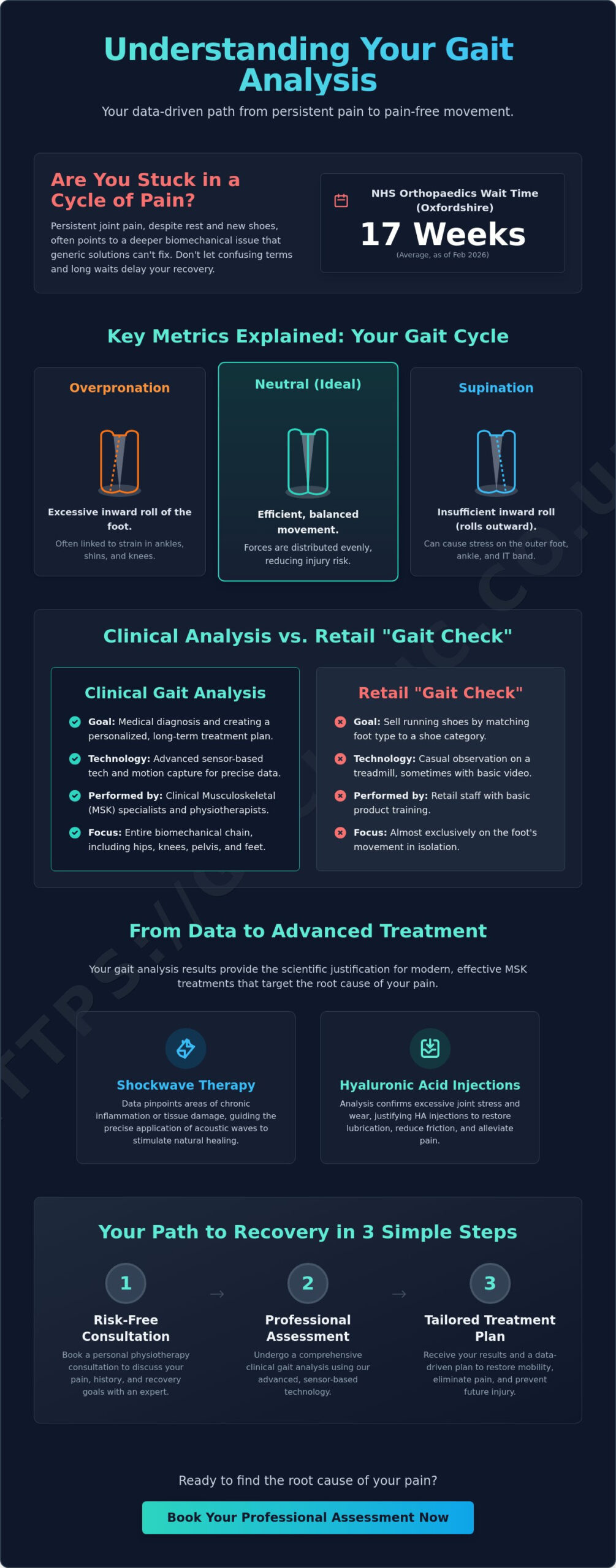
The gait cycle is the continuous period from the initial contact of one foot to the next initial contact of that same foot. It consists of two primary phases: the stance phase, which accounts for approximately 60% of the cycle while the foot is on the ground, and the swing phase, where the limb moves forward through the air. A “Neutral” gait represents the ideal baseline for efficient movement, where forces are distributed evenly across the musculoskeletal system. Achieving this balance is the primary goal when understanding your gait analysis results.
For patients in Abingdon or Kennington, identifying deviations from this neutral path is critical for long-term joint health. Overpronation is the excessive inward rolling of the foot after landing. If left unaddressed, this often leads to secondary strain in the ankles and shins. Targeted physiotherapy provides the necessary corrective measures to strengthen supporting structures and restore functional alignment.
Pronation vs. Supination: What the Data Shows
When the foot rolls inward excessively, it forces the tibia to rotate internally, which places significant stress on the medial aspect of the knee. This overpronation causes the arches to flatten, disrupting the kinetic chain and often leading to hip or lower back pain. Conversely, supination, or underpronation, occurs when the foot does not roll inward enough. This is common in individuals with high arches, resulting in poor shock absorption. The lack of flexibility means forces are transmitted directly into the bones, increasing the risk of stress fractures and ankle instability.
Whether you live in Marcham or Summertown, our clinical team analyzes how these foot-level forces impact your entire body. We identify why a seemingly minor foot issue might be the true source of chronic discomfort elsewhere. Our clinics are also conveniently accessible for residents in Faringdon, Central Oxford, and West Oxford, ensuring that professional diagnostic tools are always within reach.
Cadence, Stride Length, and Symmetry
Cadence, measured in steps per minute, and stride length are key indicators of your movement efficiency. Significant asymmetry in your results often points to an underlying injury or a subconscious compensation pattern. Ground reaction force measures the impact your joints absorb with every step; during running, this force can reach 2.5 times your body weight. High forces can accelerate joint wear if your mechanics are faulty.
Residents in Headington and Didcot can use these precise metrics to track their rehabilitation progress objectively. For those in Farmoor, Eynsham, or Witney, these data points provide a clear roadmap for recovery. If you are ready to see how your movement patterns affect your health, consider a professional biomechanical assessment at one of our Oxfordshire locations.
Clinical vs. Retail Gait Analysis: Beyond the Running Shoe
A common question we hear from patients in Abingdon and Summertown is whether a free assessment at a sports shop is sufficient. While retail gait analysis is a helpful tool for selecting footwear, it is not a diagnostic medical procedure. A video-only retail check focuses almost exclusively on the foot’s interaction with a shoe, whereas a clinical biomechanical assessment evaluates the entire musculoskeletal system. Understanding your gait analysis results in a clinical setting involves identifying underlying pathologies rather than just arch types. Our MSK clinicians in Farmoor and Eynsham possess the diagnostic expertise to see what a treadmill camera misses. We prioritize clinical accuracy.
The Limitations of Retail Assessments
Shoe-focused analysis frequently overlooks proximal issues, such as pelvic instability or hip weakness, which are often the true drivers of foot pain. For residents in Didcot or Witney, relying on a retail clerk’s advice can be risky. There is a specific danger in “self-treating” with over-the-counter orthotics without a formal clinical diagnosis. Retail analysis ignores your comprehensive medical history, including past surgeries or chronic conditions that affect your movement. We often see patients from Marcham and Kennington who have spent significant amounts on specialized shoes that failed to address their actual biomechanical dysfunction. They don’t need more shoes; they need a diagnosis.
The GB Clinic Advantage: A Holistic MSK View
We provide a “one-stop setup” in Oxfordshire that ensures you move from diagnosis to treatment without delay. Our clinicians integrate gait data with physical palpation and advanced medical imaging to confirm findings. We often utilize diagnostic ultrasound scans to visualize soft tissue structures, such as tendons and ligaments, in real-time. This holistic view is essential for patients in Headington and Faringdon who require a precise recovery plan. By combining technology with clinical reasoning, we offer a level of care that retail environments cannot match.
Residents in Central Oxford and West Oxford benefit from our evidence-based approach to physiotherapy, which targets the root cause of discomfort. We don’t just look at how you walk; we look at why your body has adapted that way. This comprehensive strategy ensures long-term relief and improved mobility for all our Oxfordshire patients. We deliver measurable results.
Translating Results into Treatment: From Data to Pain Relief
Data without application provides little value for a patient in pain. Understanding your gait analysis results serves as the clinical justification for advanced medical interventions that move beyond standard rest and ice protocols. For residents in Faringdon and West Oxford, these results allow our clinicians to prescribe targeted therapies with high precision. Whether you are travelling from Abingdon, Summertown, or Kennington, identifying exactly where your movement patterns are failing allows us to implement treatments that restore function and reduce inflammation effectively.
One primary treatment pathway involves Hyaluronic Acid (HA) injections. When gait data reveals significant joint loading or “at risk” movement patterns, HA acts as a vital lubricant for the knee or hip. These injections are proven to ease pain for up to 6 months, providing a window of opportunity for physical rehabilitation. Similarly, for gait-related pathologies like plantar fasciitis, we utilize Shockwave Therapy in Oxford. This non-invasive treatment uses acoustic waves to stimulate healing in damaged tendons, addressing the mechanical stress identified during assessments for patients in Marcham, Headington, and Farmoor.
Addressing Joint Degeneration and Arthritis
Abnormal gait patterns accelerate the wear and tear of articular cartilage. This mechanical stress often manifests as knee or hip osteoarthritis. By using HA injections to restore joint lubrication, we can mitigate the damage identified in your biomechanical report. Patients often find this particularly useful when managing medial knee soreness, a condition frequently linked to faulty foot mechanics. This proactive approach helps residents in Eynsham, Didcot, and Witney avoid the long 17-week waiting times often associated with secondary care referrals in the local NHS trust.
Targeted Rehabilitation and Exercise
Every clinical report at GB Clinic leads to a bespoke exercise plan. We don’t believe in generic “one size fits all” sheets. Instead, we use your specific stride data to target muscle weaknesses and imbalances. This often includes myofascial release techniques to correct gait-induced muscle tightness in the calves or hip flexors. We serve patients in Central Oxford with these tailored recovery protocols, ensuring each movement in your rehab plan correlates directly to a metric in your analysis. If you’re ready to move from diagnosis to relief, you can book a clinical consultation at our Oxfordshire facilities today.
Taking the Next Step: Professional Gait Assessment in Oxford
Transitioning from chronic discomfort to active recovery requires more than just a data report. At GB Clinic, we bridge the gap between complex metrics and actionable health outcomes. Understanding your gait analysis results is a collaborative process between you and our specialist clinicians. We ensure that patients from Summertown and Headington receive a clear, jargon-free explanation of their biomechanical health. Our clinics are strategically located to serve the entire Oxfordshire region, providing a professional and reassuring path to long-term recovery.
Preparing for Your Appointment
To get the most out of your session, we recommend bringing the footwear you use most frequently, whether that’s running shoes or daily work boots. This allows us to examine wear patterns that correlate with your movement data. You should also be prepared to discuss your medical history and provide specific descriptions of your pain, such as the exact timing of onset or specific triggers. A clinical assessment typically lasts 60 minutes, which is significantly more thorough than a standard 10-minute retail check. We provide direct solutions to patients in Abingdon and Kennington, ensuring no detail of your musculoskeletal health is overlooked. Our experts focus on your specific needs.
Book Your Clinical Assessment Today
If you’re ready to address the root cause of your pain, our team is here to help. We offer a FREE personal physiotherapy consultation with zero commitment for residents in West Oxford and Marcham. This risk-free entry point allows you to discuss your symptoms with an expert before proceeding with a full diagnostic assessment. Our environment is designed to be calming and professional, a standard often highlighted in our patient testimonials where practitioners are described as “brilliant” and “considerate.”
We’ve made our advanced services accessible to everyone across the county. Whether you’re in Farmoor, Eynsham, or Didcot, our one-stop setup saves you time and prevents the 17-week delays often found in traditional healthcare routes. Residents in Witney, Faringdon, and Central Oxford can rely on our modern therapies to improve mobility and restore function. Don’t let persistent pain dictate your lifestyle. Understanding your gait analysis results is the first step toward a more mobile, pain-free future. Book your consultation today and take control of your recovery with GB Clinic.
Restore Your Mobility with Expert Biomechanical Insights
Moving from persistent pain to active recovery starts with a precise diagnosis. Clinical assessments provide the scientific foundation for understanding your gait analysis results, allowing our specialists to identify the specific mechanical triggers behind your discomfort. Whether you’re visiting us from Abingdon, Summertown, or Kennington, our team focuses on evidence-based care that targets the root cause of joint degeneration rather than just the symptoms.
Residents in Marcham, Headington, and Farmoor have direct access to Oxfordshire’s trusted MSK specialists. As an advanced diagnostic ultrasound and HA injection clinic, we offer modern therapies that reduce pain and improve mobility without the long delays often found in secondary care. From Eynsham and Didcot to Witney and Faringdon, our goal is to provide a clear, professional path to long-term recovery for every patient in Central and West Oxford.
Book Your Free Personal Physiotherapy Consultation in Oxford to begin your journey toward a pain-free lifestyle. Our expert-led team is ready to help you move with confidence and comfort again.
Frequently Asked Questions
Is clinical gait analysis different from what I get in a running shop?
Clinical gait analysis is a medical diagnostic procedure conducted by qualified musculoskeletal specialists in Summertown and Headington. Unlike the 10-minute retail checks focused solely on selling shoes, our clinical assessment evaluates your entire biomechanical structure to identify specific injuries or underlying pathologies. We use advanced sensor technology to provide data that informs a medical treatment plan.
How long does a professional gait analysis session take?
A professional clinical session at our Oxfordshire facilities takes approximately 60 minutes. This duration allows for a comprehensive physical examination, data collection through advanced pressure plates or sensors, and a thorough discussion about your symptoms. It’s a much more detailed process than a retail check, ensuring we capture enough data to identify the root cause of your pain.
What should I wear for my gait analysis appointment in Oxfordshire?
You should wear shorts and a t-shirt so your clinician in Abingdon or Kennington can observe your joint alignment and muscle movement clearly. It’s also vital to bring the footwear you wear most often, whether for exercise or daily activities. Analyzing the wear patterns on your existing shoes provides valuable context for your biomechanical report.
Can gait analysis help with my chronic lower back pain?
Biomechanical assessments are highly effective for identifying the root causes of chronic lower back pain. If you live in Marcham or Farmoor and struggle with recurring back issues, we analyze how foot-level forces impact your pelvic stability and spinal alignment. Often, lower back pain is a compensatory result of poor foot mechanics or a pelvic tilt.
Do I need a GP referral for a gait assessment at GB Clinic?
You don’t need a GP referral to access our specialist services in West Oxford or Didcot. By booking directly, you bypass the 17-week average waiting time reported for local NHS orthopaedic services in February 2026. This direct access allows you to begin your evidence-based recovery plan without unnecessary delays.
What happens after I receive my gait analysis results?
Once your results are processed, our clinicians develop a targeted treatment pathway tailored to your specific biomechanical needs. This might involve advanced shockwave therapy for tendon issues or a bespoke physiotherapy program to strengthen weak muscle groups. We provide a clear roadmap from your data to long-term pain relief.
Is gait analysis suitable for people who do not run?
Walking gait assessments are beneficial for non-runners in Eynsham and Witney who experience pain during everyday movement. This analysis helps diagnose issues related to balance, hip arthritis, or joint wear that occurs during normal walking. It’s a vital tool for anyone looking to improve their mobility and reduce daily discomfort.
Can gait analysis identify a leg length discrepancy?
Precise clinical measurements can identify leg length discrepancies that are often missed during standard physical exams. Understanding your gait analysis results in this context helps patients in Faringdon and Central Oxford find relief through customized orthotics or corrective exercises. Identifying even minor discrepancies is essential for balancing the forces throughout your kinetic chain.